I still remember Coach Reed and the ritual before practice. Everybody out there together. Stretching before practice. Practice itself, and three days a week in the weight room. It continued through the year and through the summers.
Nobody asked whether we felt like exercising that day.
It was simply part of playing high school sports.
We learned the games, but we mostly prepared our bodies to play in them.
That idea is built deeply into American youth sports. High-school athletics recorded more than 8.4 million participation entries across the United States in the 2025–26 school year. Football fields, basketball courts, swimming pools, tennis courts, baseball diamonds and golf teams remain part of the educational landscape in communities large and small.
We put an extraordinary amount of effort into teaching young people how to practice.
Then something interesting happens.
They grow up.
The coach disappears. The scheduled practice disappears. The weight room is no longer at 3:30 every afternoon. There is no whistle telling everyone to line up and begin warming up.
But the person who loved the sport may still be there.
So where do we move that practice into adult life?
And how?
That question may be much more important than trying to convince everyone to join another fitness program.
We Already Know How to Do This
My niece plays high-school tennis now. She is winning tournaments and pursuing a national youth ranking.
She understands practice because sport gives her a structure for it.
A nephew dreamed about baseball. He played through high school and into college before realizing that the playing career was not going much farther. But sport still shaped where he went next. He studied sports medicine, earned a master’s degree in hospital administration and now works in a university student-health system.
Those are different outcomes from the same larger culture.
We use sports to teach young people discipline, movement, competition, teamwork, repetition, preparation and recovery.
We build fields for them.
We hire coaches for them.
We create seasons and schedules.
We organize practices.
We teach them that getting stronger on Tuesday can help with what they want to do on Saturday.
Then adulthood arrives and the instruction too often becomes:
You should exercise.
That is not much of a system.
Federal physical-activity guidance recommends that adults accumulate at least 150 minutes of moderate-intensity aerobic activity each week, together with muscle-strengthening activity on at least two days. But CDC data have shown that only about one-quarter of U.S. adults meet both the aerobic and muscle-strengthening recommendations.
Perhaps part of the problem is not that adults suddenly stopped understanding that movement is good for them.
Perhaps we made the path unnecessarily difficult.
Start With a Choice
PowerFlo begins with a much smaller proposition.
Choose to be a little healthier today.
That is enough.
You do not need a transformation.
You do not need a new identity.
You do not need to become an athlete again.
You do not need to buy a stack of equipment or organize your life around another program.
And you certainly do not need to become an expert in yoga before you can practice yoga.
Choose something useful.
Give it ten, twenty or thirty minutes.
Practice.
Then get on with your day.
Maybe it helps you feel a little stronger.
Maybe you move a little better.
Maybe you enjoy it.
Maybe having some fun is reason enough.
For someone who already loves a sport, that choice becomes even easier because there is already a reason to move.
You want to golf Saturday.
You want to play tennis tomorrow.
You have a ski trip in three weeks.
You swim in the mornings.
You still play basketball with friends.
You coach football.
You do not need another reason to exercise.
You already have one.
Yoga Does Not Need to Pretend to Be Something Else
This is where yoga has sometimes been presented strangely in American sports.
A coach may lead athletes through lunges, squats, balance positions, trunk rotation, hamstring work and shoulder mobility and call all of it “stretching.”
A trainer may call similar movements “mobility.”
Another program may call them “movement preparation.”
Those things can be perfectly legitimate descriptions of what is being trained.
But there is also no reason to become uncomfortable when some of those movements are yoga.
Chair Pose is still Chair Pose.
Warrior II is still Warrior II.
Extended Side Angle is still Extended Side Angle.
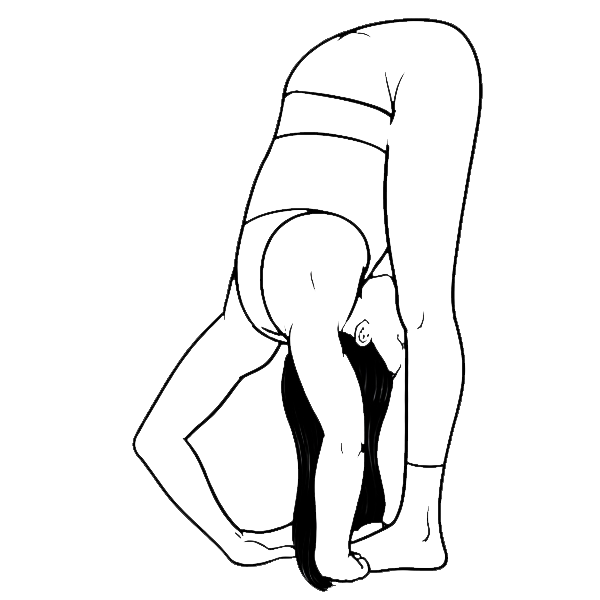
Downward-Facing Dog is still Downward-Facing Dog.
Yoga is not mysterious because its history comes from India or because some of its poses have Sanskrit names.
A physical yoga practice can be remarkably straightforward.
Stand.
Squat.
Lunge.
Rotate.
Balance.
Support your body.
Move through the hips and shoulders.
Breathe.
Hold something for a little while.
Move to the next thing.
Repeat it often enough and the strange-looking sequence becomes familiar.
That is practice.
Yoga Is Not Just Stretching
Flexibility is certainly part of yoga, but describing yoga simply as stretching misses much of the physical practice.
Take Chair Pose.
The knees and hips bend while the legs support the body against gravity. Maintain the position and the legs work.
Move from Chair into a one-legged position and balance becomes part of the problem.
Move into Warrior III and the body now has to organize the standing leg, hips and trunk while the center of mass shifts.
Move through a controlled transition into a lunge and then rise again.
That is not simply passive stretching.
Yoga can combine mobility, strength, balance and body control inside the same sequence.
Research supports a measured version of that idea. A meta-analysis examining yoga and physical fitness reported positive effects across measures including muscular strength, balance, mobility and lower-body flexibility. Research involving male college athletes has also found improvements in flexibility and balance following regular yoga practice. The studies vary considerably in style, population and methodology, so the sensible conclusion is not that yoga somehow replaces athletic training. It is that regular yoga practice can contribute to several physical qualities that matter in everyday movement and sport.
That is all it needs to do.
Yoga Does Not Teach the Sport
There is an equally important boundary.
Yoga does not teach golf.
A golf professional teaches golf.
Yoga does not teach skiing or snowboarding.
Qualified ski and snowboard instructors teach those sports.
Yoga does not teach someone how to tackle, block, throw a football, serve a tennis ball, swim the butterfly or shoot a three-pointer.
Those are skills.
They require instruction and repetition within the sport.
And yoga is not a promise against injury.
Sports contain forces and circumstances that exercise cannot eliminate. There is no pose that guarantees a skier will never catch an edge, a football player will never be hit awkwardly or a basketball player will never land on another player’s foot.
That is not the promise.
The proposition is much more reasonable:
What does your sport ask your body to do, and would you like an easy way to practice some of those physical qualities away from the game?
That is where yoga can be useful.
Golf: Keep Playing the Game
Golf may be one of the most interesting places to begin.
Golf can remain part of a person’s life for decades.
A teenager can compete.
A thirty-year-old can play with coworkers.
A retired couple can organize half their social life around the club.
Someone in their seventies may care less about adding ten yards to a drive than simply being able to comfortably play eighteen holes.
The objective changes over time, but the game remains.
And golf asks more of the body than it may appear to from a distance.
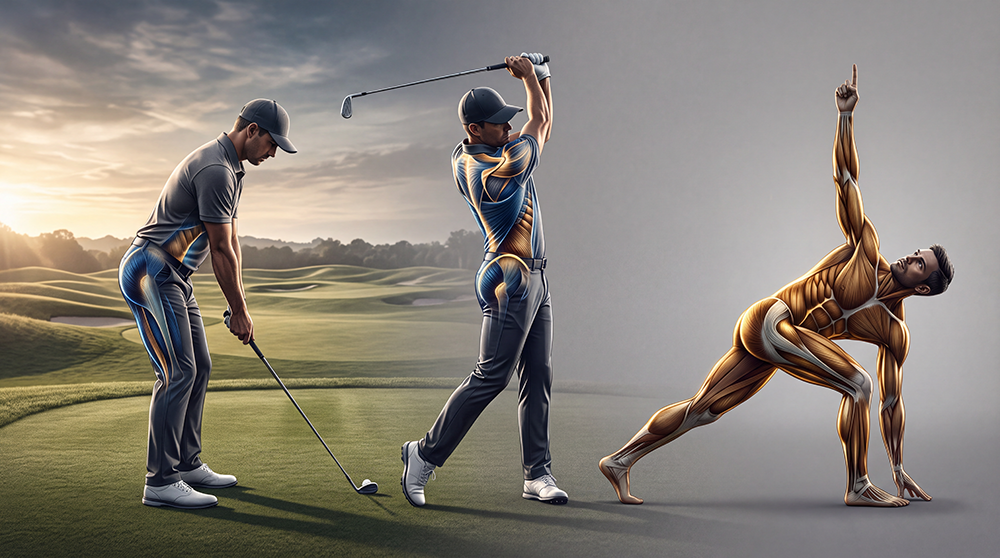
The swing involves rotation, weight transfer, balance, leg involvement and coordinated movement through the trunk and upper body.
Yoga gives the golfer a way to explore some of those qualities independently of the swing.
Chair works the legs.
Warrior III challenges balance and posterior-body control.
Triangle works through the legs, hips and lateral body.
Extended Side Angle combines an active lower body with length through the side of the trunk.
Revolved positions introduce controlled rotation.
Dancer combines standing balance with hip extension.
None of those poses needs to promise a lower handicap.
Maybe the golfer simply spends twenty minutes working on strength, balance and mobility because the golfer would like to keep golfing.
That is a perfectly good reason to practice yoga.
Coming next: Yoga for Golf
A deeper look at rotation, balance, legs, hips and the physical practice that can accompany a lifetime on the golf course.
Tennis: The Sport You Can Keep Coming Back To
Tennis provides another excellent lifetime model.
The young competitive player may train several days each week.
An adult may play league tennis.
Someone else may meet friends at the club twice a week primarily because that is where the friends are.
All of those reasons count.
Tennis asks the body to move laterally, accelerate, stop, rotate, reach and repeatedly work from asymmetrical positions.
A useful yoga practice does not need to imitate tennis.
It can work on the underlying body.
Standing poses can develop the legs.
Lateral poses can work through the hips and side body.
Balance poses challenge single-leg control.
Rotational poses move the trunk.
Shoulder positions can explore range of motion away from repeatedly swinging a racquet.
A slower practice can simply feel good after several hours on the court.
There is direct research here as well. An eight-week randomized study involving junior tennis players found improvements in a number of physical measures among participants in a yoga intervention, including aspects of balance, flexibility and core-related physical performance. That does not make yoga tennis training. It demonstrates why yoga can sit reasonably beside it.
The player still needs to serve thousands of tennis balls.
Yoga provides another place to practice the body doing the serving.
Coming next: Yoga for Tennis
Lateral movement, rotation, balance, shoulders and practices that can live alongside a lifetime on the court.
Skiing and Snowboarding: Get Ready for the Mountain
Snow sports expose the difference between wanting to do something and being physically prepared to do it.
Someone can spend Monday through Friday sitting at a desk and still expect to ski for most of Saturday.
The mountain makes no accommodation for the workweek.
Skiers know what tired legs feel like.
Snowboarders know how demanding a sustained bent-knee position can become.
People who live near the mountains understand something else: the season itself becomes a reason to train.
You want to be ready when the snow arrives.
Yoga offers an unusually natural vocabulary for that preparation.
Chair.
Crescent.
Warrior II.
Goddess.
Half Moon.
Warrior III.
Plank.
Bridge.
Standing balances.
Controlled transitions between them.
Leg strength matters.
So does the trunk.
So does balance.
So does mobility through the hips and ankles.
For snowboarding, lateral positions and trunk rotation become particularly interesting because of the stance on the board.
Nothing about that guarantees what will happen when gravity, snow, ice, speed and terrain become involved.
The yoga practice happens before and between those moments.
It gives the weekend skier something useful to do on Wednesday because the real objective is Saturday.
Then Sunday.
Then perhaps another twenty years of Saturdays.
Coming next: Yoga for Skiing and Snowboarding
Mountain legs, core strength, balance, mobility and a practical preseason and in-season practice.
Football: The Practice Before the Practice
Football is where this idea began to feel familiar to me.
I remember Coach Reed.
I remember everybody stretching.
I remember the weight room.
Nobody presented any of it as an optional lifestyle product.
It was what we did because we played football.
That is an important distinction.
A football team already understands practice.
So the question is not whether players should suddenly “get into yoga.”
The question is whether yoga contains useful movements that can fit naturally into an existing practice culture.
Of course it does.
But football also demonstrates why yoga for sports should be thoughtful.
An offensive lineman and a receiver are not doing the same job.
The lineman may have obvious uses for Chair, Goddess, Warrior II, lunges and sustained lower-body work.
A receiver may place greater emphasis on ankles, hips, single-leg control and dynamic movement.
Quarterbacks introduce different rotational and shoulder demands.
The common ground is not one magic football sequence.
It is a library of familiar movements that coaches and athletes can organize around what they need that day.
A coach should eventually be able to say:
“Chair.”
Everyone knows Chair.
“Warrior Two.”
Everyone moves to Warrior II.
“Side Angle.”
Move.
Breathe.
Next.
Once something is learned, it stops being mysterious.
It just becomes part of practice.
Coming next: Yoga for Football
A closer look at position, legs, hips, balance, mobility and how short yoga practices can fit into an established training culture.
Basketball: Control in a Game That Never Stops Moving
Basketball rarely gives the body much time to organize itself.
Run.
Stop.
Cut.
Jump.
Land.
Pivot.
Reach.
Do it again.
That makes controlled yoga practice an interesting contrast.
The movement becomes slower.
A balance position can be held long enough to notice where control is lost.
A lunge can be explored without chasing another player.
An ankle can move without simultaneously trying to change direction.
Tree, Warrior III and Half Moon create balance problems.
Chair and Crescent create leg work.
Plank variations challenge the trunk and upper body.
Hip and ankle movement can be built naturally into a sequence.
Then the player goes back to basketball.
That is the relationship.
Coming next: Yoga for Basketball
Legs, ankles, hips, balance, trunk control and movement away from the court.
Swimming: Practice on Dry Land
Swimming creates a completely different environment.
The body is horizontal.
Water supports it.
The shoulders repeat enormous numbers of movements.
Breathing becomes coordinated with the stroke.
Yoga moves the swimmer onto dry land and changes the problem.
Plank loads the body differently.
Downward-Facing Dog combines shoulders, spine, hips and legs.
Locust works through the posterior body.
Standing poses put weight through the legs.
Thoracic movement can be deliberately explored.
Controlled breathing can be practiced without simultaneously trying to breathe around water and stroke timing.
Again, the objective is not to make yoga look like swimming.
It is useful precisely because it is not swimming.
Coming next: Yoga for Swimming
Shoulders, trunk, mobility, body control and breath away from the pool.
Before, Between and After
The same yoga practice does not need to be used every time.
Sometimes the choice is:
I am about to play.
That may call for a relatively short, active practice that keeps the body moving rather than spending long periods in passive positions.
Another day the choice is:
I am not playing today. I want to work.
That practice may contain stronger holds, more balance and more demanding transitions.
After a long day of golf, skiing, tennis or competition, the choice may simply be:
I want to move slowly for twenty minutes.
That can be a different practice again.
And some days:
I have ten minutes.
Ten minutes still counts.
The important part is that the path from the decision to the practice is short.
You should not need to understand exercise programming before you can move.
Choose what sounds useful.
Begin.
What Happens After High School?
This may be the more interesting question behind all of this.
American communities put tremendous energy into youth athletics.
Even small towns have teams.
There are coaches.
There are fields.
There are gyms.
There are booster clubs, tournaments, buses, uniforms and Friday-night games.
Then the athlete graduates.
Some continue into college.
A tiny number reach professional competition.
Most do not.
But they do not cease to be people who know how to move.
The football player may eventually become a golfer.
The basketball player may start skiing.
The swimmer may continue swimming.
The tennis player may still be playing tennis fifty years later.
Someone else discovers cycling at forty.
Another starts hiking.
Another simply wants to remain capable of mowing the grass, climbing stairs, carrying groceries and getting up off the floor without making an event of it.
The objective gradually changes from competition to continuation.
That may be where yoga has its largest role in sport.
Not as something athletes graduate into.
As something that can accompany them.
And It Does Not Require a Yoga Studio
This matters particularly outside major metropolitan areas.
A community can be fifty miles from the kind of dedicated yoga culture found in a large city and still have a football team, basketball court, tennis players, golfers, runners, swimmers and people who simply want to remain active.
The movements themselves do not require a boutique fitness district.
They require some floor space and a practical way to learn what to do.
That changes access considerably.
The high-school coach who understands Chair Pose does not need to become a yoga personality.
The golfer does not need to walk into a yoga studio for the first time at seventy.
The former athlete living in a rural town does not need a specialized facility nearby.
The practice can meet the person where the person already is.
That is one of the reasons a simple digital path matters.
Not because the screen is the product.
The screen is only helping someone get from:
I should probably do something today
to:
Begin.
The Goal Is Not More Yoga
The goal is not to maximize the number of yoga classes someone completes.
It is not to keep someone staring at a screen.
It is not to create another score.
It is not to transform recreation into another obligation.
The goal is much smaller.
A person makes a choice.
Today I would like to move.
Today I would like to work on my legs.
Today my back feels stiff.
Today I want some balance work.
Today I am skiing tomorrow and would like to get moving.
Today I played eighteen holes and would like twenty quiet minutes.
Today I have ten minutes before dinner.
That is enough.
PowerFlo’s job is to make the next step easy.
A Little Healthier Is Enough
There is an enormous industry built around convincing people that they are inadequate and then selling them a transformation.
You need a new body.
A new program.
A new challenge.
A new diet.
A new identity.
Perhaps we can ask less of people.
Be a little healthier.
Move today.
Move again tomorrow if you want to.
Find something you enjoy.
Keep playing tennis.
Keep golfing.
Go skiing.
Swim.
Play basketball.
Walk the dog.
Mow the grass.
Practice yoga because you like practicing yoga.
There does not always have to be a finish line.
For sports, the best result may be remarkably simple:
You are still playing.
At twenty.
At forty.
At sixty.
At eighty if life allows it.
Yoga can be one of the things that travels with you.
Not because it guarantees anything.
Not because it replaces your sport.
And not because everybody needs to become a yogi.
It is simply an accessible practice for strength, mobility, balance, control and breathing that can change as you change.
Choose something that makes sense today.
Practice it.
Maybe have some fun.
Then go play.