Golf looks quiet from a distance.
There is no starting gun. Nobody is chasing you. There is no opponent trying to knock you down. A golfer may spend several minutes walking, talking or waiting before standing over the ball for a movement that lasts little more than a second.
That can make golf appear physically simple.
The golf swing is not.
The body has to organize the feet, legs, hips, pelvis, trunk, shoulders, arms and hands into a coordinated movement while maintaining enough balance and control to return a small clubface to a very small ball.
Then the golfer walks to the next shot and tries to do it again.
And again.
For eighteen holes.
That combination is one reason golf makes such an interesting lifetime sport—and such a natural place for yoga.
Yoga does not teach the golf swing.
It does not replace lessons, practice on the range, strength training or playing the game.
It offers something much simpler:
an accessible way to work on strength, mobility, balance and body control away from the golf course.
For someone who wants to keep playing golf, that may be reason enough to practice.
Golf Is Already a Lifetime Movement Practice
Golf is enormous.
In 2025, an estimated 48.1 million Americans age six and older participated in golf, including 29.1 million who played on a golf course and another 19 million who participated exclusively through driving ranges, simulators and golf-entertainment venues. The National Golf Foundation also reported more than 3 million beginners entering on-course golf annually in recent years.
But golf is especially interesting because it can remain part of a person’s life for decades.
Someone can begin as a teenager, play competitively in school, continue casually through a career, join a weekend group in middle age and still be playing well into retirement.
The reason for practicing may change.
At twenty, the golfer may want more distance.
At forty-five, the goal may be playing eighteen holes comfortably on Saturday after sitting at a desk all week.
At seventy-five, the goal may simply be:
I want to keep playing.
That is enough.
A useful golf-oriented yoga practice should respect that difference.
It does not need to promise a longer drive or a lower handicap.
It can simply help a golfer continue working on the body that plays the game.
The Swing Begins at the Ground
Golf is often described from the hands outward because the club is what we see.
But the golfer is standing on the ground.
The feet create the base. The legs support and reposition the body. The pelvis rotates and shifts. The trunk moves relative to the pelvis. The shoulders and arms continue the sequence before the club finally reaches the ball.
Research examining the physical determinants of golf performance consistently identifies lower-body strength and power, balance, trunk movement and other physical characteristics as relevant to the golf swing. A major review of golf-swing performance concluded that balance, muscular strength and power are associated with swing measures, with lower-body strength and power appearing particularly important.
That makes an important point about yoga for golf:
Do not begin by thinking about stretching the golfer. Begin by thinking about supporting the golfer.
Chair Pose makes more sense from that perspective.
So does Warrior II.
So does Crescent Lunge.
So does Bridge.
The golfer does not need to reproduce the golf swing on a yoga mat.
The golfer can simply practice producing and controlling force through the legs while maintaining an organized trunk.
Then go play golf.
Rotation Is Not One Thing
People frequently describe golf as a rotational sport.
That is true, but it can also be misleading.
The golf swing is not simply the spine twisting as far as possible.
The pelvis and thorax move in relation to each other. The hips contribute. The shoulders contribute. There is rotation, lateral movement and changing orientation throughout the swing.
A systematic review of golf-swing biomechanics examined 92 studies and found an extensive body of research around pelvis and torso motion, joint angles, swing plane and the sequencing of different body segments. It also found considerable methodological disagreement—an important reminder that the golf swing is more complicated than a single measurement or one ideal movement pattern.
Another study comparing proficient and average golfers found greater transverse-plane flexibility through the hips, trunk and shoulders among the more proficient group. That does not mean simply becoming more flexible produces a better golfer, but it reinforces the importance of usable rotational movement throughout the body.
This is where yoga can become useful without pretending to teach swing mechanics.
Low Lunge with rotation.
Revolved Crescent.
Triangle.
Extended Side Angle.
Open twists.
Controlled transitions between standing positions.
These movements allow a golfer to explore rotation through the hips and trunk independently of trying to hit a ball.
That is different from stretching farther for the sake of stretching farther.
The useful question is:
Can the body move where it needs to move while remaining controlled?
Mobility Is Not a Contest
Yoga can sometimes encourage the idea that more range of motion is always better.
Sports should make us more careful than that.
A golfer does not need to win a flexibility contest.
The golfer needs usable mobility.
There is a difference.
A body may possess a large passive range of motion without having much strength or control within that range. Conversely, someone may be strong but unable to move comfortably through positions the golf swing repeatedly requires.
The interesting territory lies between those extremes.
Can the hips rotate?
Can the thoracic region move?
Can the shoulders move comfortably?
Can the golfer reach those positions while the legs and trunk remain organized?
That is one reason active yoga poses can be more interesting for sport than simply sitting in long passive stretches.
Triangle is not merely a hamstring stretch when both legs remain active and the trunk has to be controlled.
Extended Side Angle combines hip position, leg work and lateral trunk movement.
Dancer / Standing Bow combines standing balance, hip extension and posterior-body control.
Half Moon asks for mobility and balance at the same time.
Warrior III asks the standing leg, hips and trunk to organize the body while its orientation changes dramatically.
The poses do not mimic golf.
They create different movement problems using some of the same physical qualities.
That is enough.
Balance Matters Because the Body Is Moving
A golfer begins from what appears to be a stable stance.
Then almost everything moves.
Pressure shifts through the feet.
The pelvis moves.
The trunk rotates.
The arms accelerate.
The club changes direction rapidly.
Yet the golfer still has to control the body well enough to strike the ball.
Research supports balance as one of the physical characteristics associated with golf proficiency and swing performance. In a study of 257 golfers across different handicap groups, highly proficient golfers demonstrated greater strength, flexibility and balance than golfers in the higher-handicap group. That does not establish cause and effect, but it shows why balance belongs in the physical conversation around golf.
Yoga provides a very easy way to practice balance because it can progressively reduce the base of support while changing the position of the rest of the body.
Tree is simple.
Warrior III is less simple.
Half Moon changes the problem again.
Dancer / Standing Bow combines standing-leg control with movement of the free leg and trunk.
None requires a golf club.
And balance practice has another advantage:
it remains useful long after someone stops caring about clubhead speed.
That matters in a lifetime sport.
Dancer Is Not a Golf Swing
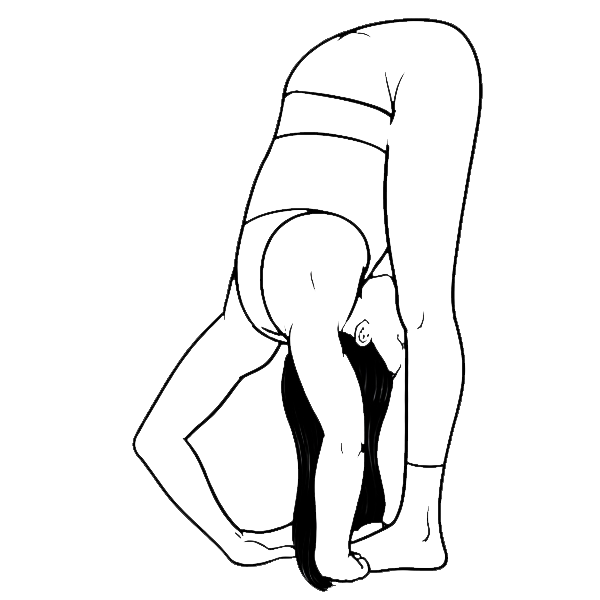
Our Yoga + Sport illustration places a golfer beside Dancer / Standing Bow.
That comparison should be understood correctly.
The golfer is not practicing Dancer because Dancer reproduces the golf swing.
It does not.
The movements are different.
What they share are physical demands.
Both ask the body to organize itself over a changing base.
Both involve the hips.
Both require trunk control.
Both involve the posterior body.
Both ask the standing leg to contribute to stability while the upper body moves away from a neutral upright position.
That is the useful relationship between yoga and sport:
Different movements. Shared physical demands.
Once that principle is understood, we no longer need to invent strange “golf poses.”
Yoga can remain yoga.
Golf can remain golf.
The Hips Matter Because the Spine Should Not Have to Do Everything
Golf places substantial rotational and other mechanical demands on the trunk.
Research into golf biomechanics has paid particular attention to the relationship between the pelvis, thorax and lumbar spine. Reviews examining golfers with low-back problems have discussed hip strength and mobility, trunk endurance, pelvis and trunk rotation, and swing mechanics as interconnected factors.
That does not mean yoga prevents back injuries.
It does not.
And it does not mean every golfer with back pain needs the same stretching routine. Pain belongs in an appropriate medical or rehabilitation conversation.
But it does reinforce something useful for the healthy golfer:
the hips and trunk work together.
If we are designing a general yoga practice around golf, it makes little sense to endlessly twist the lower back while ignoring the hips.
A better practice distributes movement.
Low Lunges can work through the hip flexors.
Pigeon variations can explore hip position when appropriate.
Warrior II and Extended Side Angle work the hips while the legs remain loaded.
Triangle combines active legs with hip and trunk movement.
Supine rotations can be used more gently during slower practices.
Bridge provides a completely different relationship between hips, trunk and posterior-body strength.
The objective is not maximum motion.
It is maintaining options.
Strength Belongs in the Conversation
Golf and yoga are both sometimes incorrectly separated from strength.
Golf is treated as a skill activity.
Yoga is treated as flexibility.
Neither description is complete.
Systematic reviews of golf conditioning programs have found that strength and conditioning interventions can improve physical characteristics relevant to golf, and many studies have reported changes in clubhead speed, ball speed or distance. These interventions often combine resistance training, core exercise, stretching and other methods, making it difficult to assign the result to one component alone.
That is exactly why PowerFlo should resist claiming:
Do this yoga sequence and hit the ball farther.
We do not know that.
We do know that strength matters.
And yoga can contain strength.
Hold Chair for five breaths.
Then ten.
Move from Chair into a controlled single-leg balance.
Hold Warrior II.
Move slowly from Crescent into Warrior III.
Use Plank and Side Plank.
Use Bridge.
Control the lowering phase rather than dropping into the next pose.
A twenty-minute yoga practice built that way is not passive.
That may be especially useful to the recreational golfer who does not have a formal strength and conditioning program and is simply looking for an approachable way to do something useful between rounds.
Before a Round Is Different From Tuesday Evening
This distinction matters.
A golfer may use yoga in several completely different ways.
If the golfer is about to tee off, the objective is not to demonstrate flexibility.
The body needs to become ready to move.
Golf-specific research supports active, dynamic warm-up approaches. A systematic review of golf warm-ups found evidence that warm-up protocols can influence performance measures, although the available research varies considerably. An experimental study comparing dynamic and static stretching found better immediate swing measures after dynamic stretching, while prolonged passive static stretching immediately before hitting has performed poorly in several golf studies.
So a Golf Ready practice should move.
A few breaths in Chair.
Dynamic lunges.
Controlled rotations.
Warrior transitions.
Shoulder movement.
Short balances.
Nothing heroic.
Nothing held forever.
Get the body moving and then go hit golf balls.
Tuesday evening is different.
There is no tee time.
Now the golfer may choose a longer practice with stronger holds, slower balance work, deeper mobility and more time on the floor.
After eighteen holes, the choice may change again.
Maybe twenty quiet minutes of slower movement feels better than another demanding practice.
Yoga becomes more useful when there is no insistence that one sequence must serve every purpose.
A Simple Golf Practice System
PowerFlo does not need fifty golf sequences.
It needs a few clear choices.
A golfer should be able to look at the day and understand what makes sense.
Golf Ready — 15 to 20 minutes
Before a round or practice session.
Active movement, short holds, hips, trunk, shoulders, legs and balance.
The objective is simply to get moving.
Golf Strength + Balance — 20 to 30 minutes
A non-playing-day practice.
Chair, lunges, Warrior variations, Warrior III, Half Moon, Plank, Side Plank, Bridge and controlled transitions.
The golfer works.
Golf Rotation + Mobility — 20 to 30 minutes
Hips, thoracic movement, shoulders and controlled rotational positions.
Not a contest to see how far someone can twist.
Golf Reset — 15 to 20 minutes
After a round or on an easier day.
Slower hips, hamstrings, shoulders, gentle trunk movement and breathing.
Golf Quick — 10 minutes
For the person who otherwise would do nothing.
Because ten minutes still counts.
These are not five products.
They are five answers to the same question:
What would be useful today?
Yoga Does Not Replace the Weight Room
A golfer who wants to become substantially stronger should strength train.
A golfer who wants maximum power should use appropriate power training.
A golfer who wants to improve swing mechanics should work with a golf professional.
A golfer recovering from an injury should work with the appropriate medical and rehabilitation professionals.
Yoga should not pretend to replace any of them.
Its advantage is different.
It can put strength, mobility, balance and controlled movement into one accessible practice.
No machines.
Very little equipment.
No complicated program to understand.
You can do it in a house, hotel room, club fitness room, condominium, backyard or beside the practice range.
For the golfer who has twenty minutes, that matters.
Golf Is Exercise Too
There is another tendency worth resisting:
the idea that golf itself does not count as physical activity.
It certainly can.
A systematic review examining golf and physical health found evidence suggesting golf participation can contribute to musculoskeletal and cardiovascular health, although results varied across studies and health measures.
Walking the course changes the physical equation considerably.
One study involving golfers between ages 30 and 80 recorded an average of nearly 12,000 steps during an eighteen-hole round, with most participants exceeding 10,000 steps.
Another study examining men of different ages found that walking eighteen holes represented meaningful exercise intensity, particularly among older golfers.
That fits the PowerFlo idea perfectly.
The goal is not to convince a golfer that golf is inadequate and yoga is somehow superior.
Golf is already movement.
Golf is already recreation.
Golf is already a reason to get outside.
Yoga can help fill some of the spaces around it.
Maybe someone walks eighteen holes Saturday.
Maybe Sunday is Golf Reset.
Maybe Tuesday is twenty minutes of strength and balance.
Maybe Thursday is mobility.
Then Saturday comes again.
That is a life, not a fitness program.
The Golfer at Seventy Is Still a Golfer
This may be where yoga and golf fit together best.
Golf gives people something to continue doing.
That matters.
Physical activity is much easier to understand when it has a purpose beyond completing physical activity.
Walk because there is another hole ahead.
Practice balance because you want to keep playing.
Work on your hips because golf is more enjoyable when moving does not feel like a negotiation with your own body.
Maintain some leg strength because an eighteen-hole day asks something of your legs.
There is a very different emotional quality to:
I have to exercise because I am getting older
and:
I want to be ready to play Saturday.
The second one has a reason attached to it.
Yoga does not need to become the destination.
It can simply help along the way.
What About the Mental Side?
Golf also contains something yoga practitioners recognize immediately:
attention.
The player cannot hit the previous shot again.
The next shot has not happened.
There is only the ball in front of you.
Golfers have created countless pre-shot routines precisely because attention matters.
Yoga works similarly in a much simpler environment.
Stand here.
Breathe.
Move.
Notice where the weight is.
Hold.
Move again.
There is nowhere else to be for that moment.
That does not require mystical language.
Nor does it require claiming that yoga will make someone mentally tougher or fix a golf game.
Sometimes twenty quiet minutes in which the phone, work, scorecard and rest of the world are irrelevant is useful simply because it is twenty quiet minutes.
Then you go play.
You Do Not Need to Become a Yogi
This may be the most important point.
The golfer does not need a new identity.
You do not have to know Sanskrit.
You do not have to join a studio.
You do not have to buy expensive clothes.
You do not have to be flexible before beginning.
And you do not have to explain to anybody at the golf club that you have suddenly become deeply interested in yoga.
You can simply practice.
Chair is Chair.
Triangle is Triangle.
Dancer is Dancer.
Extended Side Angle is Extended Side Angle.
Learn the movements.
Use the ones that make sense.
Twenty minutes later, go do something else.
Eventually the poses stop being unfamiliar.
They become movements you know.
Just like a golfer learns grip, stance, alignment and a pre-shot routine through repetition.
There is no mystery required.
The Research Does Not Say “Yoga Makes You a Better Golfer”
It is worth saying this plainly.
There is good research examining the physical characteristics associated with golf, golf biomechanics, golf conditioning and warm-up.
There is also a substantial body of research examining yoga and qualities such as strength, flexibility and balance.
There is far less evidence directly demonstrating that practicing yoga itself improves golf performance.
So we should not pretend otherwise.
The case for yoga and golf does not require exaggeration.
Golf asks for strength.
Yoga can involve strength.
Golf asks for balance.
Yoga practices balance.
Golf involves the hips and trunk moving through substantial ranges of motion.
Yoga can work on hip and trunk mobility.
Golfers may benefit from warming up before playing.
Yoga movements can form part of an active warm-up when they are selected appropriately.
That is a perfectly reasonable intersection.
We do not need to claim more.
Keep Playing
Perhaps the best golf training objective has nothing to do with the scorecard.
Keep playing.
Play with friends.
Play with your children.
Play with your parents.
Play while traveling.
Play the municipal course.
Play the country club.
Hit balls at the range.
Walk nine holes after work.
Play eighteen on Saturday.
Compete if competition makes it fun.
Stop keeping score if that makes it more fun.
The game provides the reason.
Yoga can provide one simple way to keep practicing the body that plays it.
Twenty minutes of strength.
Twenty minutes of mobility.
Ten minutes because that is all the time available.
A short practice before the round.
A slower one afterward.
No transformation required.
No promise that tomorrow’s drive will travel twenty yards farther.
Just another choice.
Be a little healthier today.
Then go play golf.