
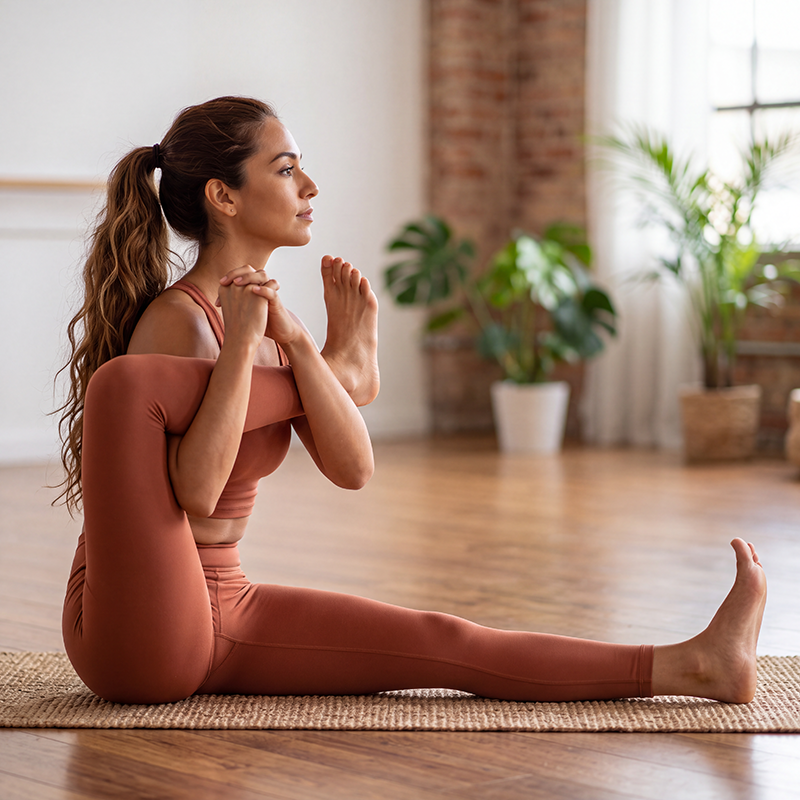
People come to yoga for different reasons.
Some want to become stronger or more flexible. Some want relief from sitting at a desk all day. Some are looking for a way to move that feels different from lifting weights, running or traditional exercise. Others arrive because life has become loud and they want an hour when they are required to pay attention to only one thing.
None of those reasons is wrong.
The interesting part is that the reason someone begins practicing yoga is often not the reason they continue.
At first, yoga can seem like a collection of physical postures. Stand here. Reach there. Balance on one foot. Hold this position. Breathe.
That alone can be valuable. A consistent practice challenges strength, mobility, balance, coordination and endurance. It asks the body to move through ranges and relationships that daily life often ignores.
But something else begins to happen when the movements are connected to breath and attention.
You start noticing things.
You notice where you are strong and where you compensate. You notice that one side of your body behaves differently from the other. You notice that balance changes from day to day. You notice when you are rushing.
You notice when you stop breathing.
That awareness may be one of the most useful things yoga teaches.
Practice Is Different From Performance
Yoga does not need an audience.
There is no scoreboard. No finish line. No requirement that the posture look like the person beside you.
You can certainly develop difficult physical skills. Yoga can become extremely demanding. Strength, mobility and coordination can advance enormously over years of practice.
But the posture itself is not really the point.
The practice is the process of paying attention while you are inside it.
Can you breathe?
Can you remain aware of what the body is telling you?
Can you distinguish productive effort from unnecessary strain?
Can you accept that today’s version of the posture may be different from yesterday’s?
Those questions matter more than whether your hand reaches the floor.
Strength and Mobility Together
Modern life often separates strength training from flexibility training.
Yoga tends to mix them.
Many postures require the body to generate force while simultaneously moving through a large range of motion. A standing pose can demand strength from the legs while opening the hips. Downward-facing dog can involve the shoulders, spine, hamstrings, calves and hands at the same time.
Transitions between poses add another layer.
Instead of simply holding positions, the practitioner learns to control movement between them.
That combination of strength, mobility, balance and coordination is one reason a well-designed yoga practice can remain challenging for decades.
The practice evolves because the body evolves.
Breath Changes the Experience
Breathing happens automatically, but yoga asks us to notice it.
That changes the experience of movement.
Breath provides rhythm. It creates a natural pace for transitions and gives the mind something consistent to return to when attention wanders.
In a strong class, breathing also becomes a useful signal.
When the breath becomes chaotic, the body may be telling you something. Maybe the effort is appropriate and challenging. Maybe you are rushing. Maybe it is time to slow down.
There is information there.
The practice teaches you to listen.
Learning to Stay
One of the quieter lessons of yoga is learning to remain present during discomfort.
Not injury. Not pain that tells you something is wrong.
Effort.
A difficult posture can create the immediate desire to escape. The muscles are working. The breath becomes louder. The mind begins negotiating.
Five breaths can feel surprisingly long.
Then the posture ends.
Nothing dramatic happened. You stayed. You breathed. You continued.
That experience repeats itself thousands of times over the life of a practice.
Eventually, the lesson becomes larger than the posture.
We discover that discomfort does not always require immediate reaction. Sometimes we can simply observe it, understand it and decide what to do next.
There Is Always More to Learn
A beginner and someone who has practiced for twenty years can stand in the same posture and be having completely different experiences.
The external shape may even look similar.
The difference is awareness.
Over time, the practitioner notices increasingly subtle relationships: the position of the pelvis, rotation of the shoulder, pressure through the feet, tension in the jaw, movement of the ribs, quality of the breath.
The posture becomes less about achieving a shape and more about understanding what is happening inside it.
That is why familiar poses do not necessarily become boring.
They become deeper.
Why Practice?
Because the human body was built to move.
Because strength is useful.
Because mobility is useful.
Because balance matters.
Because breathing consciously for an hour can change the way an hour feels.
Because learning to pay attention is valuable.
Because there will always be another layer to discover.
And because sometimes the simplest reason is enough:
You practice because practicing feels good.
You arrive.
You move.
You breathe.
And tomorrow, you begin again.
