
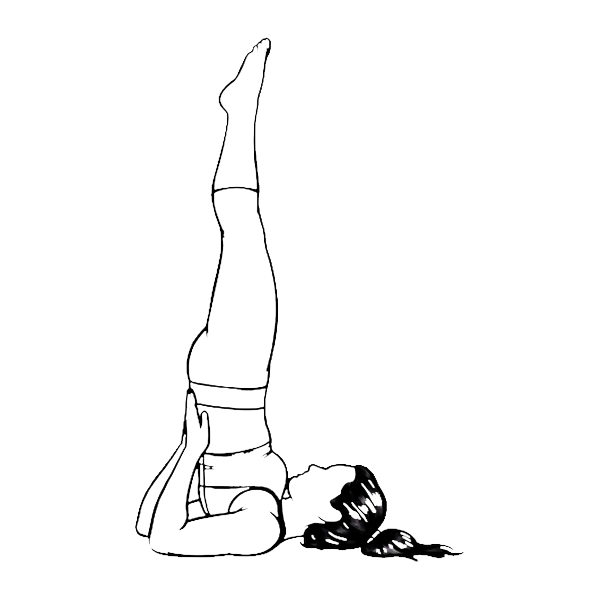
Salamba Sarvangasana
Pose family
Supported Inversion / Shoulder Stand
Body focus
Shoulders; upper back; triceps; core; hips; legs; inversion control
The Story
The Whole Body on Support
Salamba Sarvangasana translates through a cluster of practical words: salamba is “with support,” sarva is “all,” and anga is “limb.” The name points to the whole-body nature of the inversion rather than to an animal or myth. In traditional modern yoga, Shoulder Stand has often been given great importance, but PowerFlo can keep the story simple: the entire body is organized over a broad base of shoulders and upper arms while the hands support the back. The shape asks for quiet stacking. Rather than chasing perfect verticality, the practitioner builds a stable column in which support is obvious and the neck is not asked to bear the pose alone.
The Body
Supported Shoulder Stand is an inversion carried primarily through the shoulders and upper arms, with the hands supporting the back. Triceps press the upper arms into the floor while scapular stabilizers help lift the thorax away from the neck. Deep abdominal muscles and hip extensors organize the pelvis over the rib cage. Quadriceps maintain straight knees and the adductors keep the legs together. The cervical spine is flexed, so load management through the shoulders is critical; the neck should not be flattened aggressively or used as the primary base. The body’s vertical line is maintained through coordinated trunk and leg control rather than isolated neck pressure.
Instructor Anatomy
Primary muscles
Triceps; rectus abdominis; hip extensors; quadriceps
Stabilizers / secondary
Serratus anterior; rotator cuff; scapular stabilizers; deep abdominals; hip adductors
Joint actions
Cervical flexion; shoulder extension; elbow flexion; hip and knee extension; trunk stabilization in inversion
Anatomy cue
Lift from shoulders; keep neck quiet
Physiology / nervous system
Inversion changes the body's orientation to gravity and requires sustained trunk control over a shoulder-based support.
Instructor Notes
Weight on shoulders, not neck; Press upper arms down; Lift sternum toward chin; Keep legs active