
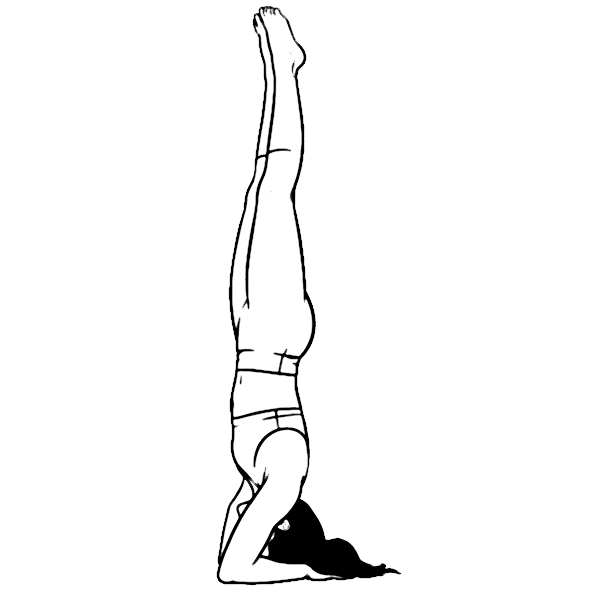
Salamba Sirsasana
Pose family
Inversion / Forearm Support
Body focus
Shoulders; upper back; arms; core; legs; neck under controlled axial load
The Story
Turn the World Over
Headstand changes almost nothing about the room and everything about your relationship to it. The floor is still the floor; gravity still works; only your orientation has changed. Supported Headstand makes that reversal a structural problem first. The forearms press, the shoulders lift, the trunk organizes, and the legs rise only after the base is dependable. The pose is sometimes treated as a symbol of mastery, but the better lesson is judgment. There is no virtue in loading the head and neck before the shoulders and core can carry their share. Use a wall, practice Dolphin, or stop at the preparation. The world will still be there when you turn it over another day.
The Body
Supported Headstand is an inversion built from a forearm base with controlled contact through the head. The forearms and elbows press strongly into the mat while serratus anterior, trapezius, deltoids, and the rotator cuff stabilize the shoulder girdle and help limit excessive cervical loading. The abdominals and spinal stabilizers control the pelvis and prevent the legs from swinging the body out of line. The quadriceps and adductors organize the legs once upright. Research on Sirsasana confirms that the head and neck can still experience substantial load and that technique changes that loading, so entry, hold, and exit all matter. If pressure in the head or neck increases, come out of the pose. Wall support, Dolphin, or a forearm-based preparation can be the better choice when the base is not yet dependable.
Instructor Anatomy
Primary muscles
Serratus anterior; trapezius; deltoids; triceps; abdominals
Stabilizers / secondary
Rotator cuff; multifidus; erector spinae; adductors; quadriceps
Joint actions
Shoulder flexion/stabilization; elbow flexion held isometrically; trunk stabilization; hip and knee extension; controlled cervical axial loading
Anatomy cue
Make the arms carry the pose; let the head remain light
Instructor Notes
Press through forearms; lift through the shoulders; if head or neck pressure increases, come out