
bharmanasana
Pose family
Quadruped / Foundation
Body focus
Wrists; shoulders; serratus; trunk; hips; knees; neutral-spine awareness
The Story
The Workbench
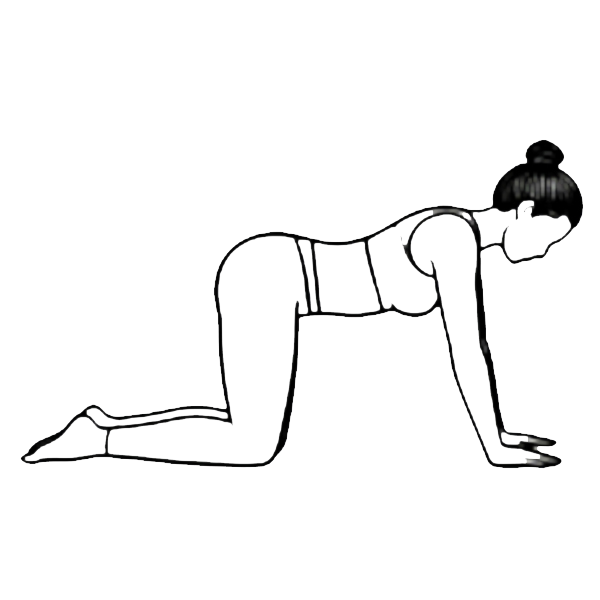
Tabletop is where the tools get laid out. Hands under shoulders. Knees under hips. Spine between Cat and Cow. Nothing heroic, nothing decorative. From here the practice can become almost anything: reach, twist, balance, round, arch, rest, crawl forward, step back. Every workshop needs a surface sturdy enough to build on. Tabletop is that surface. Learn where neutral feels like, learn how the hands meet the floor, and then let the experiments begin.
The Body
The wrists are placed under or near the shoulders and the knees under the hips, creating a quadruped base. Serratus anterior helps stabilize the scapulae against the rib cage while the rotator cuff organizes the shoulder joints. The abdominal wall and spinal stabilizers maintain a neutral position between Cat and Cow. Hip flexors and extensors share low-level work around the pelvis while the knees accept kneeling pressure. Even weight distribution through hands and knees provides substantial proprioceptive information.
Instructor Anatomy
Primary muscles
Serratus anterior; low-level abdominal and spinal stabilizers
Stabilizers / secondary
Rotator cuff; triceps; multifidus; transverse abdominis; hip stabilizers
Joint actions
Shoulder stabilization; elbow extension; hip flexion; knee flexion; neutral-spine stabilization
Anatomy cue
Neutral spine
Physiology / nervous system
Quadruped positions provide closed-chain loading through the arms and rich proprioceptive feedback while keeping the center of mass close to the floor.
Instructor Notes
Stack joints; Push floor