
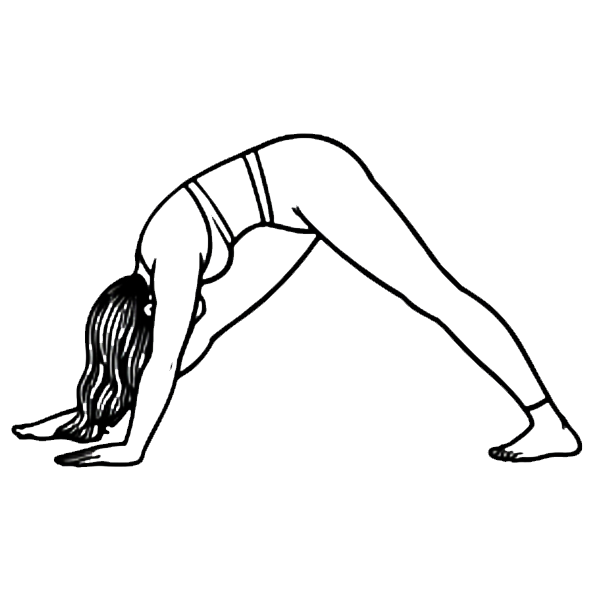
parsvottanasana
Pose family
Standing / Asymmetrical Forward Fold
Body focus
Front hamstring and calf; back leg; pelvis; shoulders; trunk; balance
The Story
Boundaries Create Freedom
Pyramid Pose is full of edges: one foot here, another there, pelvis turning forward, front leg asking for length, spine reaching out over a narrow base. The boundaries can feel restrictive until you notice what they provide. Because the foundation is clear, the upper body can travel with precision. Architecture understands this well: constraint is often what allows form to become legible. Give each foot its own place. Let the pelvis organize. Reach forward before going down. Freedom is not always having no boundaries. Sometimes it is knowing exactly where the boundaries are.
The Body
The front hip flexes over a relatively straight leg, strongly lengthening the front hamstrings and calf. The back leg remains active and helps stabilize the pelvis, which naturally wants to rotate open. Gluteus medius, adductors, and deep hip rotators help square and level the pelvis. Quadriceps maintain knee extension. If the arms are in reverse prayer or bound behind the back, the shoulders also move into extension/internal rotation or adduction depending on the variation. The spine should lengthen forward before flexing.
Instructor Anatomy
Primary muscles
Front hamstrings and calf under stretch; quadriceps; back-leg gluteals
Stabilizers / secondary
Gluteus medius; adductors; deep hip rotators; foot intrinsics; multifidus
Joint actions
Front hip flexion; both knees extension; pelvic stabilization; spinal extension then flexion; variable shoulder extension
Anatomy cue
Lengthen front side
Physiology / nervous system
Asymmetric forward folds combine flexibility with substantial balance and pelvic-control demands.
Instructor Notes
Square hips; Fold forward