
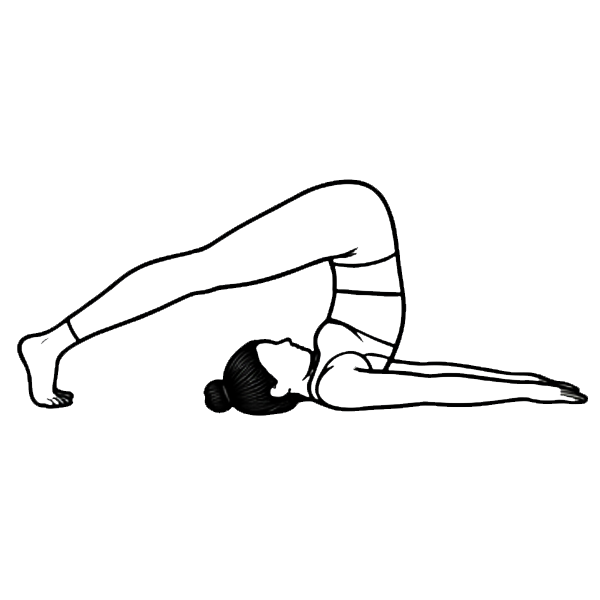
halasana
Pose family
Inversion / Forward Fold
Body focus
Posterior spine; shoulders; hamstrings; trunk; cervical-spine management
The Story
The Plow
A plow enters hard ground and turns it over so something new can grow. Halasana folds the body in the same agricultural image: legs travel overhead while the back body lengthens and the familiar orientation disappears. The metaphor is not delicate. Soil is disturbed before it is prepared. Old ground is turned. But the farmer does not attack the earth; the tool has a direction and a depth. Let the pose have the same intelligence. Go only as far as the shoulders and spine can support cleanly. Preparation is not destruction. It is making the ground ready.
The Body
Plow is both an inversion and a deep forward-folding shape. The thoracic and lumbar spine flex while the hips flex and the posterior chain lengthens. The shoulders and upper arms bear load as the trunk is supported, and the cervical spine is placed in substantial flexion. The hamstrings and spinal extensor fascia are lengthened while the abdominal wall shortens. Because the body is inverted, hydrostatic pressure relationships also change. The pose can feel quieting, but the mechanical demands on the neck and shoulders are real and should never be ignored.
Instructor Anatomy
Primary muscles
Hamstrings; spinal extensors under stretch; abdominal wall
Stabilizers / secondary
Triceps; scapular stabilizers; deep trunk muscles
Joint actions
Hip flexion; spinal flexion; shoulder extension; knee extension; inversion
Anatomy cue
Protect neck
Physiology / nervous system
Plow changes hydrostatic pressure and venous return while combining inversion with a deep forward fold.
Instructor Notes
Arms down; Legs back