
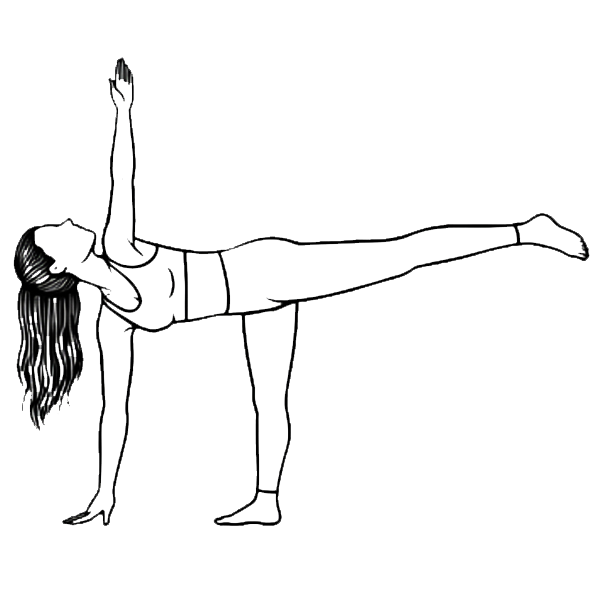
Ardha Chandrasana
Pose family
Standing Balance / Hip Opening
Body focus
Standing-leg gluteals; quadriceps; ankle stabilizers; abductors; obliques
The Story
Borrowed Light
Ardha Chandrasana means Half Moon Pose. A half moon is not half a moon at all; the whole sphere is still there, but only part of it is illuminated from where we stand. That makes a useful image for balance. In Half Moon, the body extends in several directions at once while the practitioner sees only fragments of the work: one foot pressing down, one leg reaching back, one hand touching earth, the chest opening toward the side. Stability arrives when those apparently separate actions become one shape. The pose can feel suspended between falling and flying. Rather than freezing, allow tiny corrections. Balance is not stillness. It is a continuous conversation with gravity.
The Body
Half Moon is a single-leg balance combining hip abduction, external rotation, and trunk stabilization. The standing gluteus medius and minimus are major pelvic stabilizers, assisted by the deep hip rotators, quadriceps, intrinsic foot muscles, and ankle stabilizers. The lifted leg abductors and hip extensors help maintain the long line of the body. The obliques and spinal stabilizers resist unwanted rotation or collapse while the thorax opens. A block under the lower hand can reduce the demand for hamstring length and make it easier to stack the pelvis and chest without dumping weight into the supporting shoulder.
Instructor Anatomy
Primary muscles
Gluteus medius and minimus; quadriceps; hip abductors
Stabilizers / secondary
Deep hip rotators; intrinsic foot muscles; peroneals; tibialis posterior; obliques; multifidus
Joint actions
Standing-hip stabilization; lifted-hip abduction; knee extension; trunk stabilization; thoracic rotation
Anatomy cue
Stand through the outer hip; reach through the lifted heel
Instructor Notes
Press through standing foot; lift from the outer hip; use a block before sacrificing alignment