
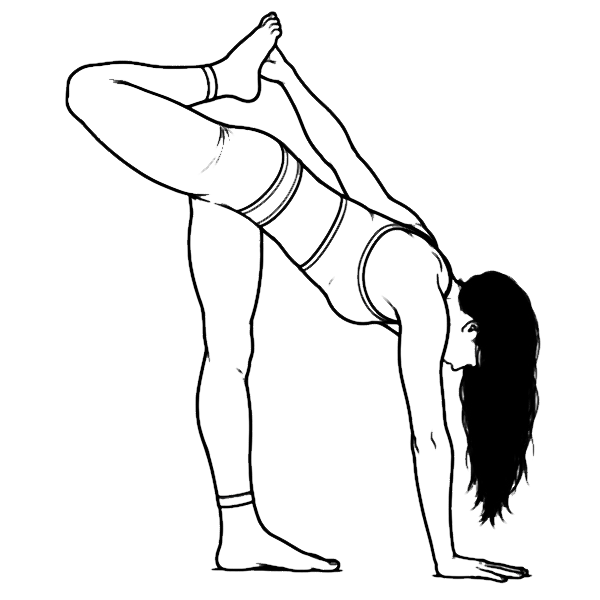
ardha chandra chapasana
Pose family
Standing / Balance / Backbend
Body focus
Standing hip stabilizers; hamstrings; quadriceps; hip flexors; chest; shoulders; spine
The Story
The Sugarcane Bow
Lalita, the radiant goddess of beauty and play, is pictured with a bow made of sugarcane and arrows made of flowers. It is a wonderfully strange weapon: sweetness given direction. Half Moon Bow carries that contradiction. You stand on one leg, open the body to the side, catch the lifted foot, and suddenly the shape becomes both balance and backbend, effort and display. Do not yank yourself into it. Let the lifted foot press back into the hand until the chest has somewhere to go. A bow works because opposing forces create one curve. Let the pose become that curve—bright, improbable, and alive.
The Body
The standing leg must stabilize the pelvis while the lifted knee bends and the lifted hip extends. Gluteus medius and the standing-leg foot/ankle complex manage balance. The lifted-leg quadriceps, especially rectus femoris, lengthens as the heel approaches the buttock; the hip flexors also lengthen. The back muscles extend the spine, while the shoulder of the reaching arm extends and organizes around the grip. The pose combines balance, backbend, quad stretch, and chest opening in one asymmetric load.
Instructor Anatomy
Primary muscles
Standing-leg gluteus medius/quadriceps; spinal extensors; lifted-leg hamstrings
Stabilizers / secondary
Foot/ankle stabilizers; deep abdominals; rotator cuff; multifidus
Joint actions
Standing hip stabilization; lifted knee flexion and hip extension; spinal extension; shoulder extension
Anatomy cue
Stack standing hip
Physiology / nervous system
Balance demand, large-range hip motion, and back extension create strong proprioceptive input.
Instructor Notes
Kick back; Lift chest