
Chaturanga Dandasana
Pose family
Arm Balance / Strength
Body focus
Triceps; chest; shoulders; serratus anterior; core; legs; full-body load transfer
The Story
Strength Without Hardness
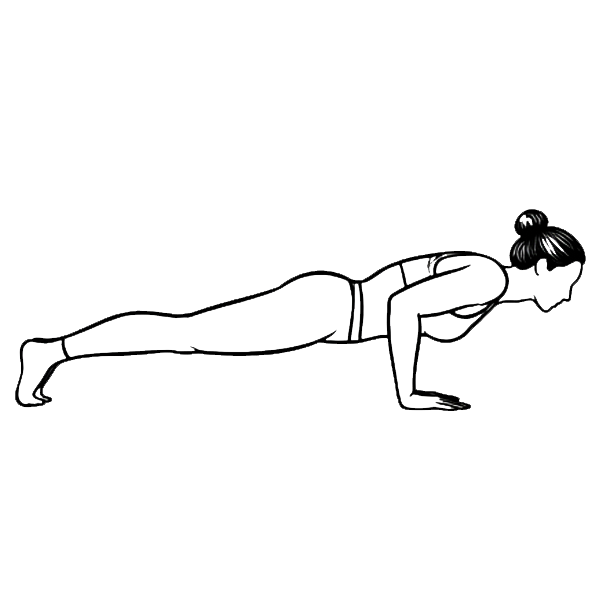
Chaturanga Dandasana is Four-Limbed Staff Pose. The image is almost severe: four points on the floor and one long body held between them. But the useful lesson is not rigidity. A staff is strong because it keeps its line, not because it fights itself. In Chaturanga the body learns the same distinction. The arms work hard, the legs reach back, the center stays organized—and the breath is still allowed to move. That combination is what makes the pose interesting. Muscular effort is obvious; unnecessary tension is harder to see. The jaw can soften while the triceps work. The eyes can stay quiet while the whole body bears load. Strength does not have to look angry. Sometimes the more complete expression of strength is control without drama.
The Body
Chaturanga is a loaded horizontal position supported by the hands and feet. The triceps control elbow flexion, while pectoralis major and anterior deltoid contribute to shoulder control. Serratus anterior helps keep the scapulae organized against the rib cage, and the rotator cuff stabilizes the glenohumeral joint. The trunk functions as a rigid bridge: abdominals, spinal stabilizers, gluteals, quadriceps, and the posterior chain prevent the pelvis from sagging or piking. Elbows track generally back rather than flaring wide. Lower only as far as shoulder, scapular, and trunk control can be maintained. Knees-down Chaturanga is a valid way to reduce load while preserving the essential upper-body pattern.
Instructor Anatomy
Primary muscles
Triceps brachii; pectoralis major; anterior deltoid; serratus anterior
Stabilizers / secondary
Rotator cuff; transverse abdominis; obliques; gluteals; quadriceps; spinal stabilizers
Joint actions
Controlled elbow flexion; shoulder extension from plank alignment; scapular protraction/stabilization; trunk anti-extension; hip and knee extension
Anatomy cue
Move as one plank
Instructor Notes
Elbows track back; Keep shoulder blades supported; Move as one unit; Knees down to scale load