
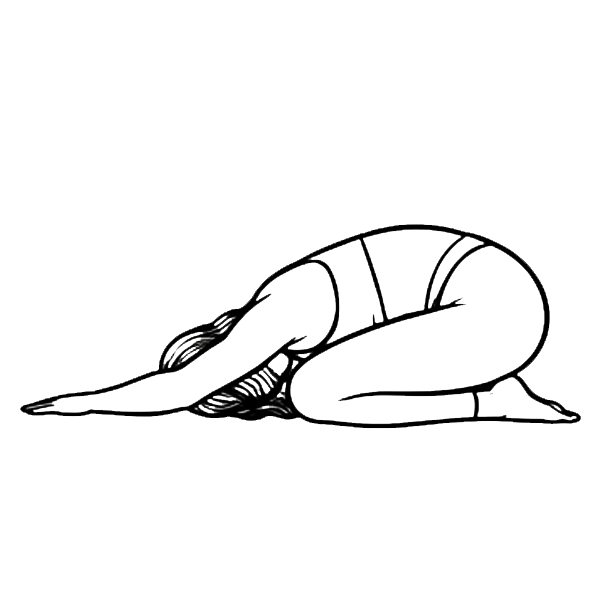
Balasana
Pose family
Resting / Forward Fold
Body focus
Upper and low back; hips; shoulders; passive posterior-body stretch
The Story
Return to the Child
Child’s Pose folds the world down to almost nothing: knees, earth, forehead, breath. Adults spend a great deal of life reaching outward, explaining, defending, producing, proving. A child can simply curl up and stop. Balasana remembers that possibility. It is not defeat and it is not laziness. It is the decision to become small enough for a moment that nothing has to be solved. Feel the floor under the forehead. Let the back widen with the breath. The practice will still be there when you rise. Rest is not outside the work. Sometimes rest is the part that allows the work to remain human.
The Body
Child’s Pose is primarily passive. The front of the body softens while the back body lengthens. The rhomboids, middle trapezius, posterior shoulders, and tissues along the spine can release as the torso settles forward, with additional length through the hips and quadriceps depending on the variation.
The shape can also change how the breath is felt: contact with the thighs and floor encourages expansion into the back and side ribs. Knee width, arm position, and support under the body can substantially change the experience.
Instructor Anatomy
Primary muscles
Erector spinae; latissimus dorsi; gluteus maximus (primarily lengthened)
Stabilizers / secondary
Minimal active stabilization in the supported resting version
Joint actions
Hip flexion; knee flexion; spinal flexion; shoulder flexion when arms reach forward
Anatomy cue
Soften ribs
Instructor Notes
Hips back; Reach forward