
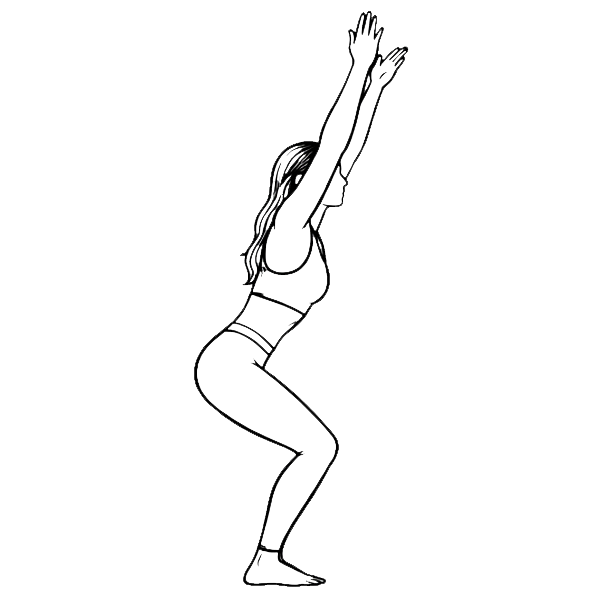
Utkatasana
Pose family
Standing Strength
Body focus
Quadriceps; gluteals; ankles; spinal extensors; shoulders; trunk stabilization
The Story
The Invisible Throne
Utkata means fierce, powerful, immense. Somewhere along the way we gave the pose a chair, but there is no chair. You sit anyway. That absence is what makes the shape interesting: the body commits to a support that does not exist and discovers that the legs can become the support. Imagine a throne if you like—not as decoration, but as responsibility. To sit there you must carry your own weight. The thighs burn, the breath gets louder, and the mind immediately begins negotiating. Stay. Not forever. Just long enough to learn that discomfort and danger are not the same thing, and that strength can be quiet even when the muscles are working very hard.
The Body
Chair Pose combines a squat with an upright, lengthened torso. The quadriceps work eccentrically and isometrically to control and maintain knee flexion, while the gluteus maximus and other hip extensors help control the pelvis. The ankles dorsiflex as the shins incline forward, making the calves and intrinsic foot muscles part of the foundation.
The erector spinae and quadratus lumborum help keep the torso lifted while the abdominals organize the ribs and pelvis. With the arms overhead, the deltoids, serratus anterior, trapezius, and rotator-cuff muscles coordinate upward rotation and stabilization of the shoulder blades.
Instructor Anatomy
Primary muscles
Quadriceps; gluteus maximus; erector spinae; deltoids
Stabilizers / secondary
Hamstrings; calf complex; intrinsic foot muscles; transverse abdominis; serratus anterior
Joint actions
Hip flexion; knee flexion; ankle dorsiflexion; shoulder flexion/upward rotation
Anatomy cue
Weight midfoot
Instructor Notes
Sit back; Knees track