
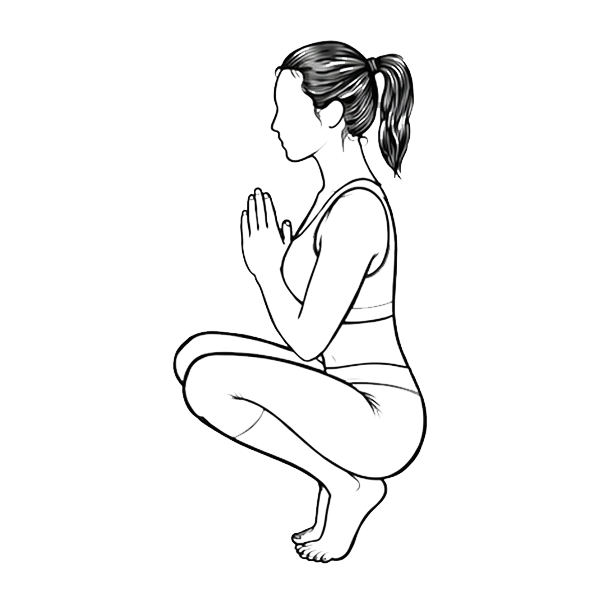
Padangusthasana
Pose family
Toe Balance / Deep Squat
Body focus
Feet; ankles; calves; quadriceps; hips; balance; core
The Story
Balance on a Small Point
Toe Stand is a modern balancing posture most strongly associated with Bikram-style practice. Its Sanskrit label, Padangusthasana, literally points toward the big toe, although that same or similar name is also used elsewhere for a very different standing forward fold. The naming overlap is a good reminder that yoga vocabulary is not always one pose to one word. Here the practice is unmistakable: the entire body learns to organize over a very small base. There is nothing mystical required. The challenge itself is the teacher. When the base becomes tiny, unnecessary movement becomes obvious, the gaze matters, and calm attention becomes as practical as ankle strength.
The Body
Toe Stand places the supporting ankle in strong plantarflexion while the knee and hip are deeply flexed. The calf complex maintains the raised heel and the intrinsic muscles of the foot help control pressure through the forefoot. Quadriceps and gluteals stabilize the bent leg, while the crossed leg uses hip external rotation and flexion. Gluteus medius and the deep hip rotators help keep the pelvis centered. Because the center of mass sits over such a small contact area, the deep abdominals and spinal stabilizers make subtle corrections to keep the trunk organized. Visual focus is a major component of balance.
Instructor Anatomy
Primary muscles
Gastrocnemius; soleus; quadriceps; gluteus maximus
Stabilizers / secondary
Intrinsic foot muscles; gluteus medius; deep hip rotators; deep abdominals
Joint actions
Supporting ankle plantarflexion; deep knee flexion; hip flexion; crossed-leg hip external rotation
Anatomy cue
Lift through center over forefoot
Physiology / nervous system
A very small base of support increases proprioceptive demand and makes visual focus especially important.
Instructor Notes
Spread toes; Lift through center; Keep gaze steady; Do not collapse into the supporting ankle