
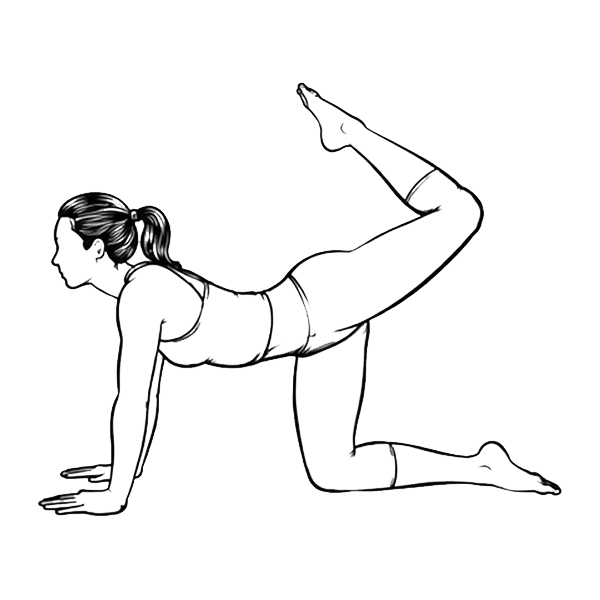
Vyaghrasana
Pose family
Quadruped Balance / Backbend
Body focus
Gluteals; hamstrings; spinal extensors; shoulders; core; hip extension
The Story
Wake Like a Tiger
Vyaghra means tiger. The pose borrows the image of a tiger stretching after rest—long through the spine, powerful through the hind leg, alert without hurry. It is a straightforward animal metaphor rather than a complicated myth. From hands and knees, one leg lifts and bends as the chest reaches forward. The body discovers how much movement can happen in the hip and upper back without losing the stable tabletop beneath it. Think of an animal waking: the stretch is whole-body, instinctive, and coordinated. The supporting limbs stay quiet so the moving leg can become expressive.
The Body
Tiger begins from quadruped and adds unilateral hip extension, knee flexion, and spinal extension. Gluteus maximus and hamstrings lift the thigh while the hamstrings also flex the knee. Erector spinae contribute to the backbend, but the deep abdominals limit excessive lumbar compression. On the supporting side, serratus anterior, rotator cuff, triceps, and intrinsic hand muscles stabilize the shoulder and wrist. The grounded hip is controlled by gluteus medius and the deep hip stabilizers. Because one leg is moving behind the body, the trunk must resist unwanted rotation and maintain a stable tabletop base.
Instructor Anatomy
Primary muscles
Gluteus maximus; hamstrings; erector spinae
Stabilizers / secondary
Transverse abdominis; multifidus; gluteus medius; serratus anterior; rotator cuff; triceps
Joint actions
Lifted hip extension; lifted knee flexion; spinal extension; supporting shoulder flexion/stabilization
Anatomy cue
Press floor; lift from hip
Physiology / nervous system
Contralateral trunk and shoulder stabilization help control rotation as the lifted leg moves behind the body.
Instructor Notes
Press the floor away; Keep pelvis level; Lift from the hip; Spread backbend through the whole spine