
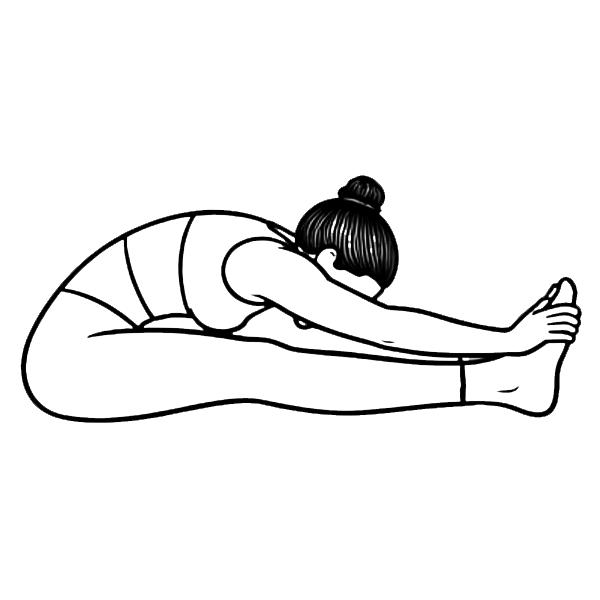
pascimottanasana
Pose family
Seated / Forward Fold
Body focus
Hamstrings; calves; gluteals; spinal extensors; posterior fascial chain
The Story
The West Side of the Body
Paschimottanasana carries the old image of the west—the back side of the body for a practitioner traditionally oriented toward the rising sun. The name turns anatomy into geography. Sit facing your own horizon and fold over the legs as though traveling across a landscape you have inhabited your entire life but rarely explored. The hamstrings, calves, back, breath, and mind all have opinions about how far you should go. Listen without obeying every demand. A horizon is not something you reach. It is something that gives direction to the journey.
The Body
The hips flex over extended knees while the posterior chain lengthens: calves, hamstrings, gluteals, and spinal extensor tissues all participate. Ray Long notes that active hip flexors—including psoas, pectineus, rectus femoris, and sartorius—help rotate the pelvis forward. When the hands connect with the feet, force can be transmitted along the chain into the spine, which is why pulling harder is not necessarily better. A productive fold comes from hip motion and axial length rather than collapsing the lumbar spine to reach farther.
Instructor Anatomy
Primary muscles
Hamstrings; gastrocnemius/soleus; gluteals; spinal extensors under stretch
Stabilizers / secondary
Iliopsoas; rectus femoris; sartorius; deep abdominals
Joint actions
Hip flexion; knee extension; spinal axial length with variable flexion
Anatomy cue
Lead with pelvis
Physiology / nervous system
Forward folds are commonly experienced as calming, especially when held without strain. Lowering the head and reducing visual demand may contribute.
Instructor Notes
Sit tall; Fold hips