
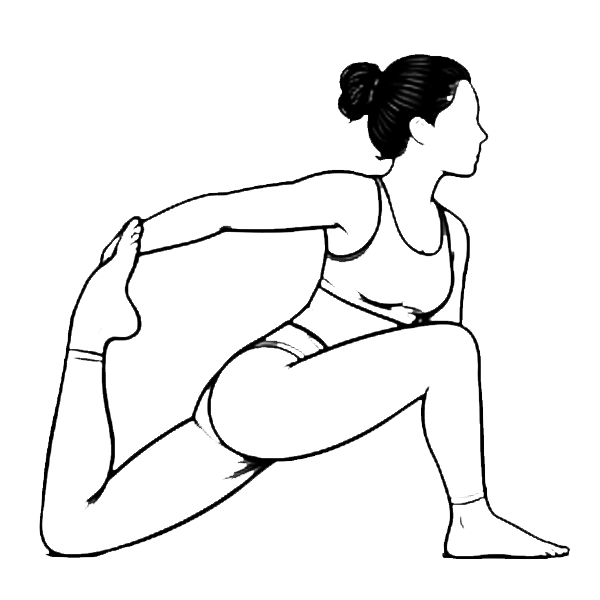
Parivrtta Eka Pada Rajakapotasana
Pose family
Low Lunge / Quadriceps Opening / Twist
Body focus
Back-leg quadriceps and hip flexors; gluteals; obliques; shoulders; thoracic spine
The Story
The Pigeon Turns Toward the Sky
Revolved King Pigeon takes an already complicated relationship between hips, thigh, spine, and shoulders and adds rotation. In the reference variation, the back knee stays grounded, the rear foot lifts, one hand catches it, and the opposite hand supports the body as the chest turns open. The pose can look dramatic, but the useful sequence is simple: establish the lunge, pad the back knee, lengthen the front of the rear thigh, then rotate. The foot is the last piece, not the first. If the twist disappears when you grab the foot, use a strap or release the grip. A regal pigeon should still be able to breathe.
The Body
This variation combines a low lunge with back-knee flexion and thoracic rotation. The back-leg rectus femoris is lengthened strongly because the hip extends while the knee flexes; the iliopsoas is also lengthened across the hip. The front gluteals, quadriceps, and foot stabilize the lunge. Obliques and multifidus create and control the twist while the supporting shoulder bears part of the body weight. Reaching for the rear foot adds shoulder extension or rotation depending on the grip. Padding under the back knee and using a strap can reduce unnecessary strain and allow the torso to stay long.
Instructor Anatomy
Primary muscles
Back-leg rectus femoris and iliopsoas in stretch; front gluteals and quadriceps; obliques
Stabilizers / secondary
Multifidus; deep abdominals; supporting shoulder stabilizers; intrinsic foot muscles
Joint actions
Front-knee flexion; back-hip extension; back-knee flexion; thoracic rotation; reaching-shoulder rotation
Anatomy cue
Make the twist first; take the foot only if the twist survives
Instructor Notes
Pad the back knee; lengthen before twisting; use a strap before sacrificing the chest rotation