
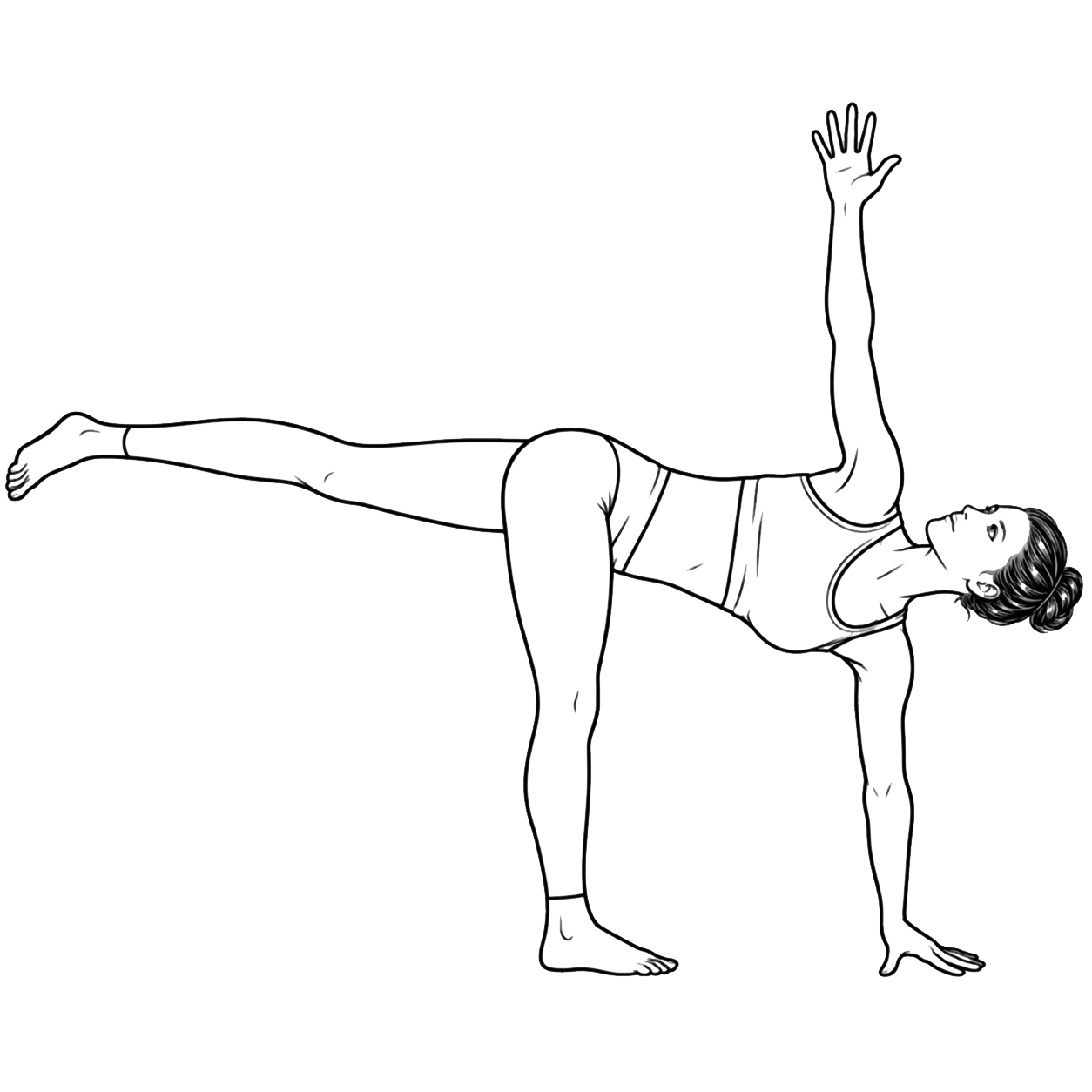
Parivritta Ardha Chandrasana
Pose family
Standing Balance / Twist
Body focus
Standing-leg stability; gluteals; hamstrings; obliques; thoracic rotation; shoulder line
The Story
Moonlight in a Turning World
Ardha Chandra is the half moon; parivritta adds the act of turning or revolving. The name gives the pose its entire visual problem: keep the quiet clarity of Half Moon while the torso rotates through space. A moon does not stop being a moon because our viewpoint changes. In the same way, this balance asks for a stable center while the visible shape turns around it. The image is modern rather than a claim of ancient mythology, but it is useful: one leg becomes the earth, one leg reaches like a long horizon, and the ribs rotate without letting the pelvis spin away. The pose is steadiness inside motion.
The Body
Revolved Half Moon combines a single-leg hip hinge with axial rotation. The standing quadriceps maintain knee extension while gluteus medius and the deep hip stabilizers keep the pelvis controlled over the foot. The lifted leg is held in hip extension by gluteus maximus and the hamstrings. Obliques, multifidus, and other spinal rotators turn the rib cage while the deep abdominals limit excessive movement through the lumbar spine. The shoulders abduct into a vertical line, requiring rotator-cuff and scapular control. Balance also depends heavily on the ankle and intrinsic foot muscles making constant small corrections.
Instructor Anatomy
Primary muscles
Gluteus medius; gluteus maximus; hamstrings; obliques
Stabilizers / secondary
Quadriceps; deep abdominals; multifidus; rotator cuff; intrinsic foot muscles
Joint actions
Standing hip flexion; lifted hip extension; axial spinal rotation; shoulder abduction; knee extension
Anatomy cue
Square hips; rotate ribs
Physiology / nervous system
Single-leg balance combines ankle-foot proprioception with trunk rotation and sustained visual focus.
Instructor Notes
Square hips; Lengthen lifted heel; Rotate ribs rather than yanking the neck