
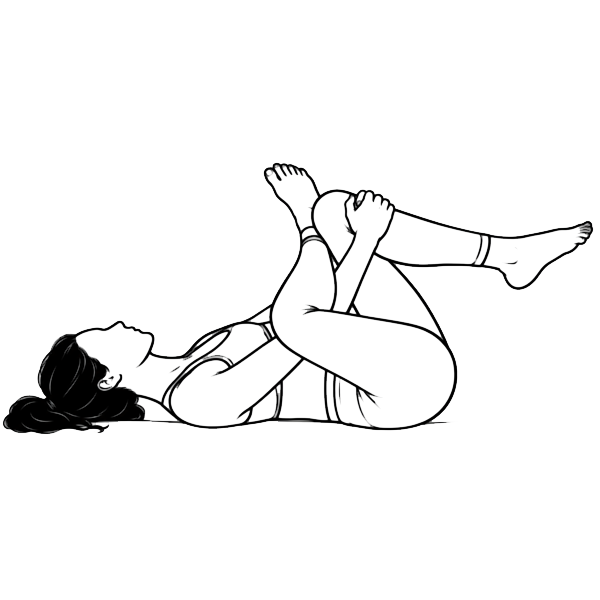
Sucirandhrasana
Pose family
Supine / Figure Four / Hip Opening
Body focus
Crossed-leg gluteals and deep external rotators; supported pelvis and spine; opposite hip flexion
The Story
The Figure Four at Rest
Reclined Figure Four is the quiet version of a shape that later appears standing and even in arm balance. Modern yoga commonly calls it Eye of the Needle, Reclining Pigeon, or Sucirandhrasana. On the back, balance disappears from the problem and the hip can be studied without asking the standing leg to work. Cross one ankle over the opposite thigh, keep the crossed foot active, and draw the supporting thigh toward the body only as far as the outer hip can receive it. The useful lesson is restraint: the knee does not need to be pressed toward the floor. The opening belongs at the hip, while the spine and pelvis stay supported by the ground.
The Body
The crossed hip moves into flexion, abduction, and external rotation, placing the gluteal complex and deep lateral rotators under stretch. The crossed knee is flexed and the ankle is held in dorsiflexion. The opposite hip and knee flex as the thigh is drawn toward the torso, usually with assistance from the arms. Because the back is supported, balance demand is minimal and the practitioner can control intensity by changing how close the supporting thigh comes to the chest. Keeping the sacrum and shoulders heavy reduces the tendency to substitute spinal rounding for hip motion.
Instructor Anatomy
Primary muscles
Gluteus maximus; posterior gluteus medius/minimus; piriformis and deep hip external rotators of the crossed leg
Stabilizers / secondary
Deep abdominals; hip flexors of the supporting leg; ankle dorsiflexors; shoulder and arm flexors when actively drawing the thigh
Joint actions
Crossed hip flexion, abduction and external rotation; crossed knee flexion; ankle dorsiflexion; opposite hip/knee flexion; supported trunk stabilization
Anatomy cue
Flex crossed foot; move from the hip
Physiology / nervous system
Supine support removes most balance demand and makes the intensity of the outer-hip stretch easy to regulate by changing how far the supporting thigh is drawn in.
Instructor Notes
Flex crossed foot; Keep sacrum heavy; Draw thigh in; Do not press knee