
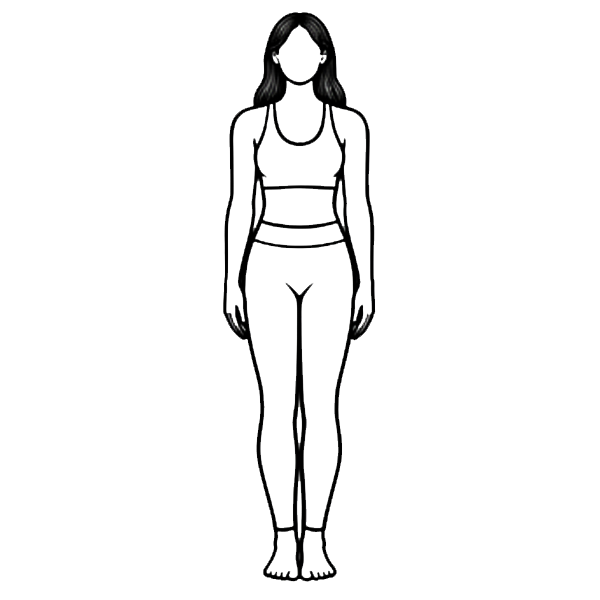
Tadasana
Pose family
Standing Foundation
Body focus
Feet and ankles; quadriceps; hip stabilizers; trunk; scapular stabilizers
The Story
The Mountain Beneath Every Pose
A mountain does not chase balance. It belongs to the earth so completely that rising seems inevitable. Tadasana asks a human body to discover a little of that quality. Stand. Feel the feet spread into the floor. Let the crown rise without leaving the ground. Nothing dramatic has to happen. In fact, the less you interfere, the more interesting standing becomes. Wind moves around mountains. Weather changes. Light changes. The mountain remains in relationship with all of it. Perhaps balance is less about resisting every force and more about knowing where you belong among them.
The Body
Mountain Pose looks quiet, but balance is being solved continuously from the feet upward. The intrinsic foot muscles and calf musculature make small postural corrections while the quadriceps organize the knees. The gluteus medius, tensor fascia lata, adductors, and other hip muscles help keep the femurs and pelvis centered.
The psoas and gluteal muscles balance the pelvis from front and back. The spinal extensors and abdominal wall maintain the trunk over the pelvis, while the rhomboids and trapezius organize the shoulder blades. Tadasana is therefore less a state of muscular relaxation than a low-level coordination problem distributed through the whole body.
Instructor Anatomy
Primary muscles
Quadriceps; calf musculature; gluteus medius; spinal extensors
Stabilizers / secondary
Intrinsic foot muscles; adductors; tensor fascia lata; deep abdominals; rhomboids; trapezius
Joint actions
Neutral standing alignment; knee extension; ankle stabilization; pelvic and scapular stabilization
Anatomy cue
Stack joints
Instructor Notes
Root feet; Stand tall