
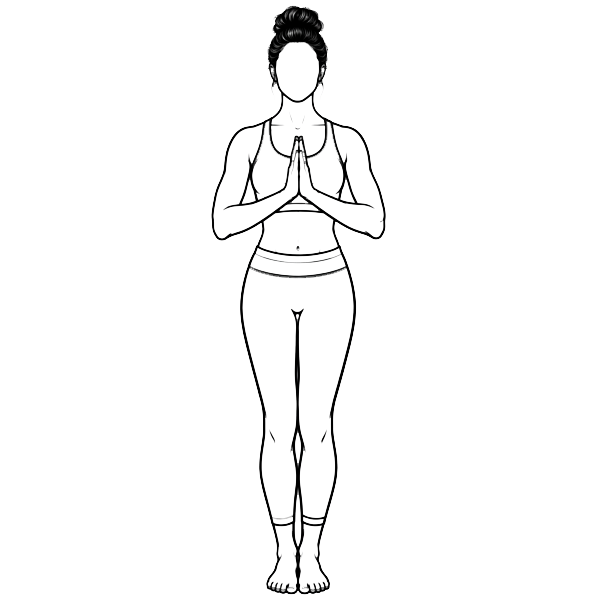
Tadasana / Anjali Mudra
Pose family
Standing Foundation / Centering / Mudra
Body focus
Feet and ankles; quadriceps; hip stabilizers; trunk; chest; shoulders; forearms and hands
The Story
Hands Meet at the Heart
Mountain Hands At Prayer keeps the architecture of Tadasana but changes the intention of the shape. Anjali means an offering or salutation, and bringing the palms together at the center of the chest has long been used as a gesture of composure, greeting, and return to center. That makes this more than Mountain Pose with different hands. The feet still root and the spine still rises, but the hands create a deliberate midpoint: left and right meet, attention gathers, and the pose can mark arrival, transition, gratitude, or completion. In a sequence, ordinary Mountain can function as a neutral standing reset. Mountain Hands At Prayer has a different job. It asks the practitioner to stand with the same structural clarity while adding an unmistakable gesture of intention.
The Body
The lower body retains the organization of Tadasana. Intrinsic foot muscles and the calf complex make continuous postural corrections, the quadriceps maintain knee extension, and the gluteus medius, adductors, and deep trunk muscles help keep the pelvis centered over the feet. The difference appears in the upper body. The elbows flex and the hands meet in front of the sternum. Gentle, even palm-to-palm pressure recruits the hand and forearm musculature and can lightly engage the pectoral muscles while the serratus anterior, trapezius, rhomboids, and rotator-cuff muscles organize the shoulder blades. The goal is not to squeeze the palms hard. Keep the sternum buoyant and the shoulders away from the ears so the gesture does not collapse the chest or create unnecessary neck tension.
Instructor Anatomy
Primary muscles
Quadriceps; calf musculature; spinal extensors; pectoralis major; forearm and hand musculature
Stabilizers / secondary
Intrinsic foot muscles; gluteus medius; adductors; deep abdominals; serratus anterior; lower trapezius; rhomboids; rotator cuff
Joint actions
Neutral standing alignment; knee extension; ankle stabilization; elbow flexion; palms meeting at midline; scapular stabilization
Anatomy cue
Root feet; palms meet without lifting shoulders
Physiology / nervous system
Bringing the hands together at the midline adds tactile and proprioceptive input and can serve as a simple attentional anchor for steady breathing.
Instructor Notes
Root feet; Lift sternum; Palms meet evenly; Soften shoulders