
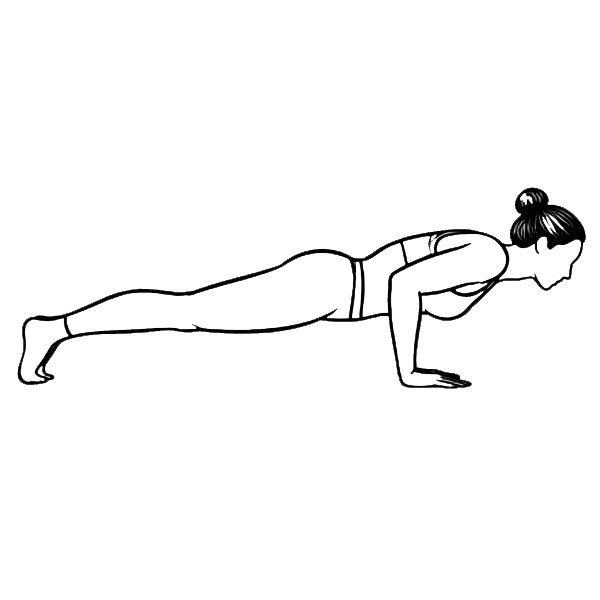
Chaturanga Dandasana
Pose family
Plank / Transition / Whole-Body Strength
Body focus
Triceps; serratus; pectorals; deltoids; abdominals; quadriceps; wrists; shoulder control
The Story
Four Limbs, One Staff
Chaturanga Dandasana means Four-Limbed Staff. The name is almost an engineering drawing. Hands and feet touch the earth; everything between them becomes one long member under load. The temptation is to think of it as a push-up and let the shoulders do the suffering. The richer image is the staff: one object, one line, force shared throughout. Shift forward, bend the elbows, keep the body connected. Strength is not proving that one joint can tolerate everything. Strength is teaching the whole structure to participate.
The Body
The elbows flex while the triceps control the descent eccentrically and then hold the body close to the floor. Serratus anterior, pectorals, rotator cuff, and scapular stabilizers keep the shoulder girdle organized. The abdominal wall prevents the lumbar spine from sagging, while gluteals and quadriceps maintain the legs as part of the staff. Shoulders drifting well below elbow height or collapsing forward can increase stress at the anterior shoulder. Chaturanga is therefore a whole-body strength posture, not merely an arm exercise.
Instructor Anatomy
Primary muscles
Triceps; pectoralis major/minor; anterior deltoids; rectus abdominis; quadriceps
Stabilizers / secondary
Serratus anterior; rotator cuff; transverse abdominis; gluteals; scapular stabilizers
Joint actions
Elbow flexion under load; shoulder stabilization; spinal anti-extension; hip/knee extension
Anatomy cue
Keep body long
Physiology / nervous system
Repeated Chaturanga builds shoulder and trunk strength and endurance while accumulating load through the wrists and shoulders.
Instructor Notes
Shift forward; Elbows back