
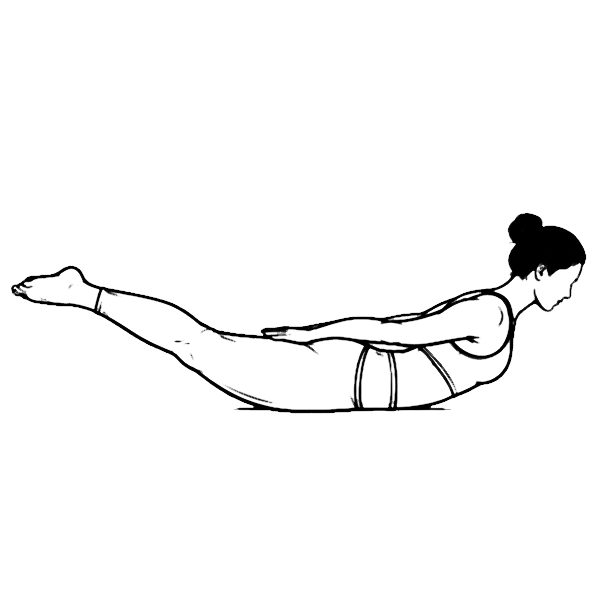
salabhasana
Pose family
Prone Backbend / Posterior-Chain Strength
Body focus
Erector spinae; quadratus lumborum; gluteus maximus; hamstrings; upper back; posterior shoulders
The Story
Lift Like a Locust
A locust stays close to the ground until suddenly it does not. Salabhasana carries that tiny act of defiance. Lie face down, gather the back body, and lift away from the earth without losing the length of the body. The movement is not large, but gravity makes it honest. Imagine the sternum and heels reaching away from one another as though the body were being drawn taut across the floor. Rise because the whole line is participating, not because one part is being squeezed harder. Small creatures can contain surprising power.
The Body
Locust Pose is a prone backbend built largely by posterior-chain strength. The erector spinae and quadratus lumborum extend the spine while the gluteus maximus and hamstrings extend the hips and lift the thighs. The quadriceps keep the knees long as the legs reach back.
Depending on arm position, the lower trapezius, rhomboids, posterior deltoids, and triceps help organize the upper back and shoulders. Because the floor fixes the front of the pelvis and abdomen, the pose gives clear feedback about whether the lift is being distributed through the legs, hips, and thoracic spine rather than concentrated only in the lumbar spine.
Instructor Anatomy
Primary muscles
Erector spinae; quadratus lumborum; gluteus maximus; hamstrings
Stabilizers / secondary
Quadriceps; lower trapezius; rhomboids; posterior deltoids; deep trunk stabilizers
Joint actions
Spinal extension; hip extension; knee extension; shoulder extension/retraction depending on arm position
Anatomy cue
Lengthen back body
Instructor Notes
Reach legs; Lift chest