
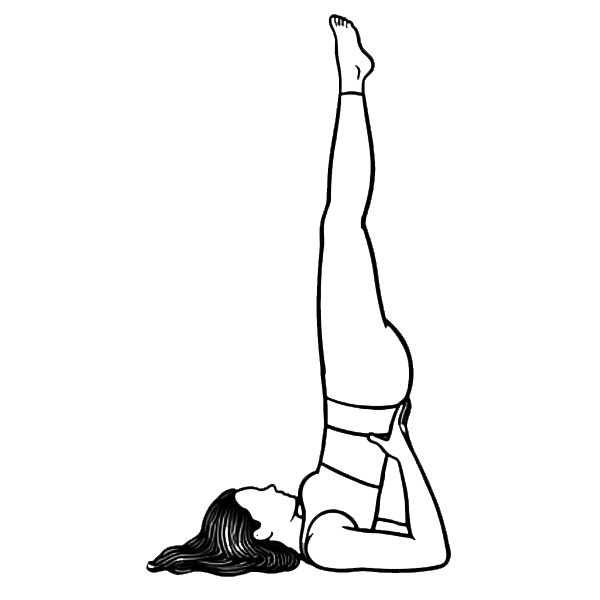
viparita karani mudra
Pose family
Inversion
Body focus
Shoulders; upper back; trunk; legs; cervical-spine management; inversion physiology
The Story
The Inverted Lake
Turn the body upside down and the familiar map changes. The feet rise where the head usually lives; the heart finds a different relationship with gravity; the room stays exactly where it was while you become the strange thing inside it. The old image of Viparita Karani is a reversal, a turning around. Shoulder Stand adds another image: the body rising from a carefully built base. Do not make verticality the prize. Let the shoulders become the shore and the legs the reflection lifting from the lake. Sometimes seeing the world differently requires no new world at all—only a different orientation.
The Body
Whether the practitioner takes a more diagonal Viparita Karani-style inversion or a more vertical Shoulderstand, the mechanical priorities are similar: support through the shoulders and upper arms, controlled trunk organization, and protection of the cervical spine. The scapular stabilizers, spinal extensors, abdominal wall, gluteals, and legs coordinate to hold the body against gravity. In the more vertical version, the demand on the shoulder girdle and trunk increases. As an inversion, the posture changes hydrostatic pressure gradients and venous return compared with upright standing; cardiovascular reflexes may respond, but the effect varies with the individual and the exact setup.
Instructor Anatomy
Primary muscles
Triceps; spinal extensors; gluteals; quadriceps
Stabilizers / secondary
Serratus anterior; rotator cuff; deep abdominals; multifidus; scapular stabilizers
Joint actions
Shoulder extension/external rotation; scapular stabilization; spinal/hip extension; inversion
Anatomy cue
Keep neck free
Physiology / nervous system
Inversion alters hydrostatic pressure and venous return and can engage cardiovascular reflexes.
Instructor Notes
Shoulders down; Legs up