
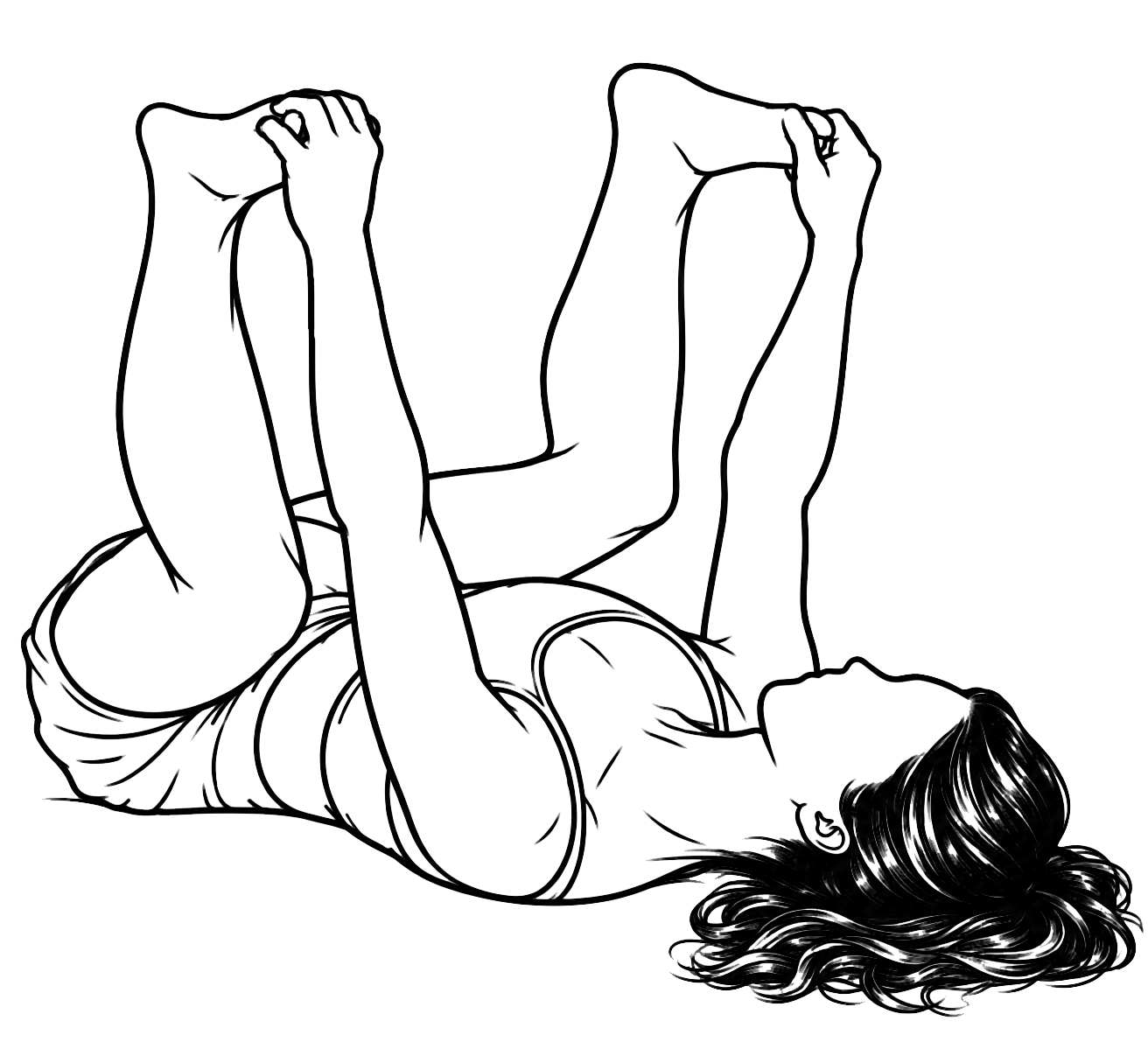
ananda balasana
Pose family
Supine / Restorative Hip Opening
Body focus
Inner thighs; hips; sacrum; posterior pelvis; low-back release
The Story
Remember the Baby
Babies find their feet and immediately understand that this is hilarious. They roll onto their backs, grab their toes, rock from side to side, and explore the body as though it were a new toy—which, to them, it is. Happy Baby gives adults permission to remember that relationship. Lie down. Take hold of the feet. Let dignity become optional. The hips open, the back meets the ground, and there is nowhere to go. Ananda means joy or bliss. Sometimes joy is not mysterious. Sometimes it is simply being allowed to play with the body you have.
The Body
Lying on the back removes the demand of balance and allows the hips to flex, abduct, and externally rotate while the knees bend. The adductors and portions of the gluteal complex lengthen, the sacrum broadens against the floor, and the lumbar spine can settle after stronger standing work, backbends, or twists. The shoulders stay broad and relatively quiet. Because the body is supported by the floor, the practitioner can modulate intensity simply by changing the grip or how far the knees descend.
Instructor Anatomy
Primary muscles
Hip adductors; gluteal muscles; hamstrings
Stabilizers / secondary
Deep hip rotators; abdominal wall; shoulder stabilizers
Joint actions
Hip flexion, abduction and external rotation; knee flexion; sacral grounding
Anatomy cue
Relax shoulders
Physiology / nervous system
The supine position reduces postural demand and can support a shift toward lower muscular effort. Slow breathing and a supported body position reinforce its restful quality.
Instructor Notes
Sacrum down; Knees wide