
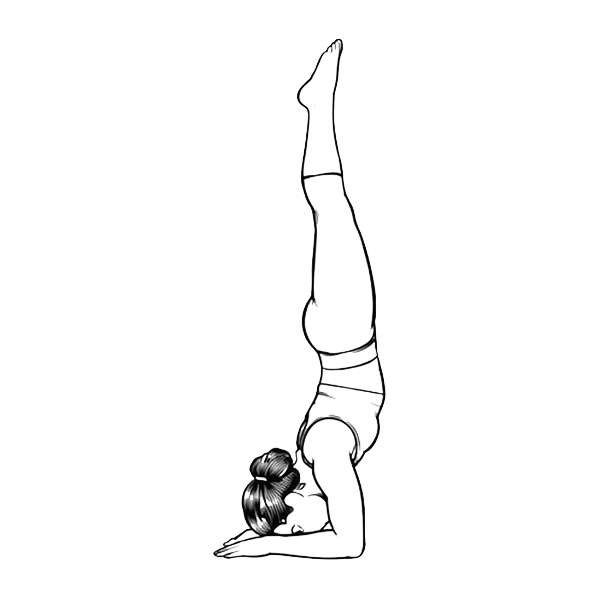
Pincha Mayurasana
Pose family
Forearm Inversion / Balance
Body focus
Shoulders; forearms; serratus; upper back; core; hips; legs
The Story
The Peacock Feather
Pincha Mayurasana is often translated as Feathered Peacock Pose or Forearm Stand. Pincha refers to a feather or tail feather and mayura to the peacock. The image is elegant: a vertical body rising from the forearms like a long feather lifted into the air. The pose rarely feels elegant while it is being learned. It asks for patience with fear, repeated preparation, and the willingness to make small balance corrections without panic. The peacock image is useful because lightness comes from structure. Press the forearms down, lift the shoulders away from the floor, and let the legs rise from a stable trunk rather than kicking the body into a loose arc.
The Body
Forearm Balance is an inversion supported by the forearms and elbows. Serratus anterior, rotator cuff, deltoids, and upper-back muscles stabilize the shoulder girdle while the forearms press firmly into the floor. The trunk requires strong deep-abdominal engagement to prevent the lumbar spine from collapsing into an exaggerated backbend. Gluteals, quadriceps, and adductors organize the pelvis and legs overhead. Because the base is narrower than Shoulder Stand but broader than a handstand, the practitioner makes continuous balance corrections through the forearms, shoulders, and trunk. Shoulder flexion range is a major structural requirement.
Instructor Anatomy
Primary muscles
Deltoids; serratus anterior; triceps; rectus abdominis
Stabilizers / secondary
Rotator cuff; trapezius; transverse abdominis; gluteals; hip adductors
Joint actions
Shoulder flexion/stabilization; elbow flexion; trunk stabilization; hip and knee extension
Anatomy cue
Press forearms; lift shoulders
Physiology / nervous system
Inverted forearm support combines sustained shoulder loading with proprioceptive balance and strong trunk control.
Instructor Notes
Press forearms down; Lift shoulders away from floor; Zip inner legs; Keep ribs from spilling forward