
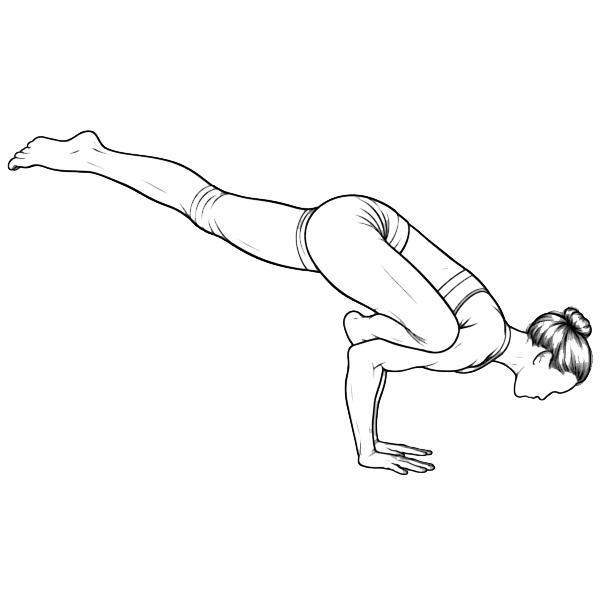
Eka Pada Galavasana
Pose family
Arm Balance / Hip Opening
Body focus
Wrists; shoulders; core; outer hip; gluteals; extended back leg
The Story
Galava Takes Flight
Eka Pada Galavasana is named for the sage Galava: eka is one, pada is foot or leg, and Galava is the name of the sage. Later traditions tell of Galava as a devoted student of Vishvamitra whose insistence on repaying his teacher sent him on a difficult journey. The pose has its own difficult journey: a figure-four hip shape leaves the floor and becomes an arm balance while the free leg extends back. The modern English name Flying Pigeon describes the visible form; the Sanskrit name keeps the sage in view. Both suggest the same practice quality—commitment without rigidity, and enough patience to let the lift appear rather than forcing it.
The Body
Flying Pigeon combines an arm balance with deep external rotation of the front hip and extension of the back leg. The hands bear weight in wrist extension while triceps, serratus anterior, pectoral muscles, and the rotator cuff stabilize the bent-arm platform. The front shin presses into the upper arms; deep hip external rotators and gluteal tissues accommodate that figure-four position. The extended back leg uses gluteus maximus and hamstrings to reach behind the body. Rectus abdominis, transverse abdominis, and hip flexors keep the pelvis lifted. The pose depends on a deliberate forward shift of body weight so the back foot can become light.
Instructor Anatomy
Primary muscles
Triceps; serratus anterior; rectus abdominis; gluteus maximus
Stabilizers / secondary
Rotator cuff; transverse abdominis; deep hip external rotators; wrist/finger muscles; gluteus medius
Joint actions
Wrist extension; elbow flexion; front hip flexion/external rotation; back hip extension; scapular protraction
Anatomy cue
Press shin; reach back heel
Physiology / nervous system
The pose combines strong upper-limb loading with hip mobility and a forward center-of-mass shift.
Instructor Notes
Flex front foot; Press shin into arms; Look forward; Reach back heel; Keep elbows tracking