
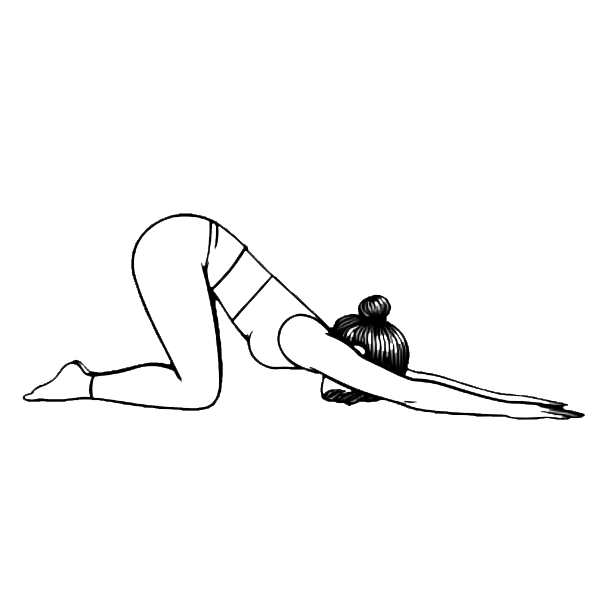
Uttana Shishosana
Pose family
Kneeling / Shoulder Opening / Forward Extension
Body focus
Shoulders; latissimus dorsi; chest; thoracic spine; upper back
The Story
The Reach Before the Leap
A puppy stretches with complete commitment. Front paws travel away, chest drops toward the floor, hips stay high, and for a moment the whole animal is simply reach. Extended Puppy Pose turns that instinctive gesture into a deliberate shape. It sits between Child’s Pose and Downward-Facing Dog: not quite rest, not quite weight-bearing strength, but a long opening through the shoulders and spine. The name gives the pose permission to be curious rather than severe. Walk the hands forward and see what is available today. The chest may never touch the floor. It does not need to. The value is in creating length from the hands through the sides of the ribs while the hips stay organized above the knees.
The Body
Extended Puppy keeps the hips roughly over the knees while the arms reach forward and the chest moves toward the floor. This places the shoulders into substantial flexion and can lengthen latissimus dorsi, teres major, pectoral tissues, triceps, and the side body while encouraging thoracic extension. The hands remain active so the shoulder girdle is supported rather than hanging passively into end range. Keep the front ribs from dropping excessively, which can shift the movement into lumbar extension instead of the upper back and shoulders. If the shoulders or neck feel compressed, support the forehead or chest and reduce the depth. The pose should feel like distributed length, not a pinch at the front of the shoulder.
Instructor Anatomy
Primary muscles
Latissimus dorsi; teres major; triceps brachii; pectoralis major/minor
Stabilizers / secondary
Serratus anterior; rotator cuff; deep abdominals; spinal stabilizers
Joint actions
Shoulder flexion; scapular upward rotation; thoracic extension; hip flexion with knees flexed
Anatomy cue
Lengthen through the ribs, not the low back
Instructor Notes
Hips over knees; Keep arms active; Draw front ribs in; Support forehead if neck or shoulders compress