
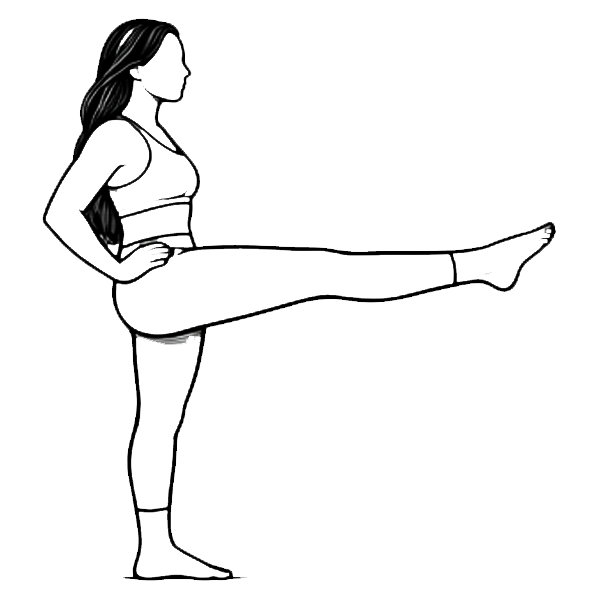
utthita eka padasana
Pose family
Standing / Single-Leg Balance
Body focus
Standing foot and ankle; quadriceps; gluteus medius; hip flexors; lifted-leg quadriceps; core; gaze
The Story
Balance Without a Handle
Lift one straight leg and leave the hands free. Suddenly there is nothing to grab, no strap, no toe, no railing—only your relationship with the ground and the space around you. Extended One-Foot Pose makes balance feel exposed in a useful way. The mind may immediately start issuing orders to the ankle, thigh, abdomen, and shoulders. Try something else. Pick a distant point. Feel the floor rising to meet the standing foot. Let the lifted heel reach forward as if space itself were receiving it. Your body can manage more of the details than your conscious mind can. Give it the problem and stop shouting instructions.
The Body
The standing foot and ankle continuously adjust while the quadriceps and gluteus medius keep the knee and pelvis organized. The lifted leg requires sustained hip flexion from iliopsoas, rectus femoris, sartorius, and related hip flexors while the quadriceps hold the knee extended. The abdominal wall and spinal stabilizers prevent the torso from leaning backward to counterbalance the leg. Visual focus, vestibular input, and proprioception from the standing foot all contribute to keeping the center of mass over a very small base.
Instructor Anatomy
Primary muscles
Standing-leg quadriceps and gluteus medius; lifted-leg iliopsoas, rectus femoris, sartorius and quadriceps
Stabilizers / secondary
Foot intrinsics; tibialis anterior/posterior; calf; deep abdominals; multifidus
Joint actions
Standing ankle stabilization; lifted hip flexion; lifted knee extension; pelvic stabilization
Anatomy cue
Keep ribs stacked
Physiology / nervous system
Single-leg stance continuously integrates visual, vestibular, and proprioceptive input while the foot, ankle, hip, and trunk stabilize the body.
Instructor Notes
Stand tall; Lift leg