
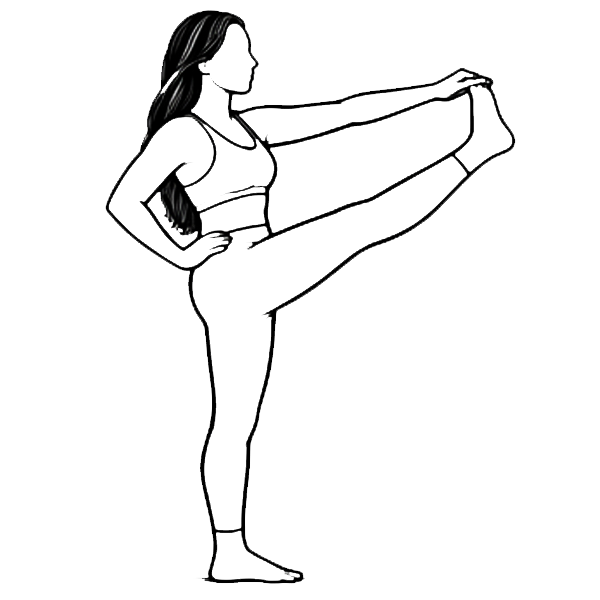
utthita hasta padangusthasana
Pose family
Standing / Balance / Hamstring
Body focus
Standing foot and ankle; quadriceps; gluteus medius; hamstrings; hip flexors; core; gaze
The Story
The Balance Comes Last
A lifted leg is obvious. The real pose is underneath it. Extended Hand-to-Big-Toe begins with the standing foot, the floor, gravity, and the quiet negotiation that keeps a human being upright. Let the leg rise only after that relationship is clear. Instead of thinking through every ankle muscle and hip correction, notice the room. Feel the ground pushing back. Reach the crown of the head toward the space above you and the lifted heel toward the horizon. The body already knows an astonishing amount about standing. Give it a clear direction and let it organize itself. Balance is not something you clamp onto. It is something you enter.
The Body
The standing leg creates the base. Intrinsic foot muscles, tibialis posterior/anterior, calf musculature, quadriceps, and gluteus medius stabilize the ankle, knee, and pelvis. The lifted leg combines hip flexion with knee extension, placing the hamstrings under length while the hip flexors help hold the leg. The abdominal wall and spinal stabilizers keep the trunk from leaning backward to compensate. The visual system, vestibular system, and proprioceptive information from the standing foot continuously negotiate balance.
Instructor Anatomy
Primary muscles
Standing-leg quadriceps and gluteus medius; lifted-leg hip flexors; hamstrings under stretch
Stabilizers / secondary
Intrinsic foot muscles; tibialis posterior/anterior; calf; deep abdominals; multifidus
Joint actions
Standing ankle stabilization; hip flexion; knee extension; pelvic stabilization
Anatomy cue
Level pelvis
Physiology / nervous system
Single-leg balance requires continuous integration of visual, vestibular, and proprioceptive input.
Instructor Notes
Stand tall; Extend heel