
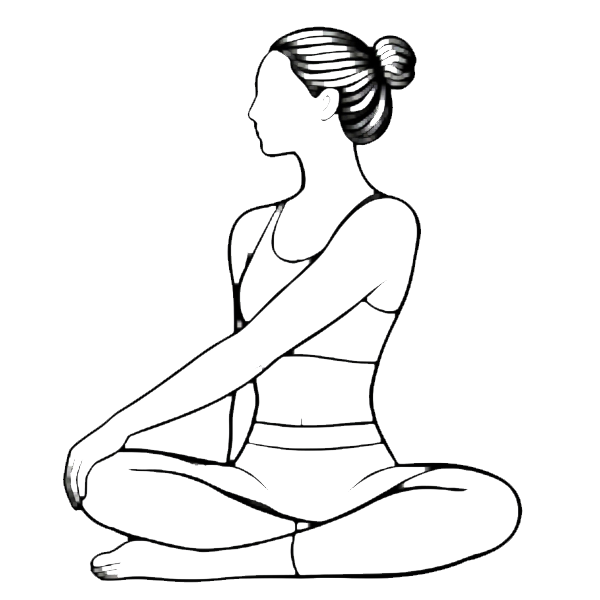
Parivrtta Sukhasana
Pose family
Seated Twist
Body focus
Thoracic and lumbar rotation; obliques; multifidus; hips; postural control
The Story
Turn and Return
A simple seated twist is one of yoga’s clearest demonstrations that movement does not have to be large to change perspective. You stay in the same seat. The pelvis remains grounded. The spine grows taller, and then the ribs begin to turn. Suddenly the room is different. One shoulder moves behind you, the gaze follows, and something that was outside your field of view appears. The important part is the return. A twist is not an escape from where you started. You rotate, breathe, notice, and come back to center carrying a little more information about the body than you had before. The pose is simple enough that the sensation can be the teacher rather than the shape.
The Body
Easy Twist begins from a supported cross-legged seat and adds axial rotation of the spine. First establish pelvic support and spinal extension; twisting a collapsed spine usually shifts motion into the easiest segments rather than distributing it comfortably. The internal and external obliques contribute to rotation, while multifidus and smaller segmental muscles help control the vertebrae. The hand behind the body is a support, not a jack for forcing greater range, and the hand on the opposite knee should guide rather than lever. Keep both sitting bones grounded and let the rotation progress from the lower ribs through the thoracic spine, with the head turning last and only as far as the neck remains comfortable.
Instructor Anatomy
Primary muscles
Internal and external obliques; multifidus; rotatores
Stabilizers / secondary
Erector spinae; transverse abdominis; pelvic stabilizers; deep neck stabilizers
Joint actions
Axial spinal rotation; hip flexion/abduction/external rotation; cervical rotation as a continuation of thoracic rotation
Anatomy cue
Lengthen, then rotate
Instructor Notes
Get tall before turning; Ground both sit bones; Use hands as guides, not levers; Head turns last