
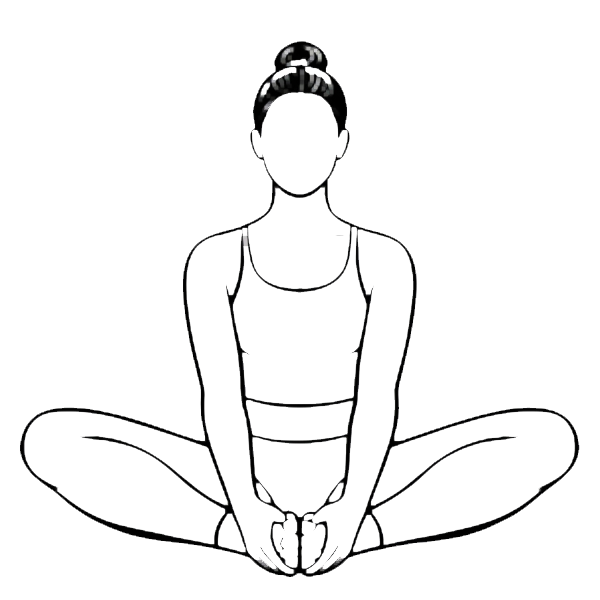
baddhakonasana
Pose family
Seated / Hip Opening
Body focus
Adductors; deep hip external rotators; pelvic floor; upright spinal support
The Story
The Butterfly Opens Its Wings
Sit close to the earth, bring the soles of the feet together, and the knees become wings. That is enough of a story. A butterfly does not force itself open; it unfolds because unfolding is what it has become ready to do. Children understand the pose immediately and often start moving the knees before anyone tells them to. Adults can learn from that. There is no prize for pressing the legs flat. Let the shape be alive. Let the hips open at the speed they open. The body is allowed to have its own season. Some days the wings barely move. Some days they fall toward the floor. Both are still the butterfly.
The Body
The thighs move into flexion, abduction, and external rotation while the knees flex and the soles meet. The adductor group along the inner thighs lengthens as the deep external rotators organize the femoral heads in the sockets. Sitting tall asks the spinal extensors and deep trunk muscles to maintain axial length without hardening the groins. The pelvic floor changes shape with the position of the pelvis and responds dynamically to breathing; it is not simply ‘stretched’ or ‘strengthened’ in one direction. The useful work is spaciousness at the hip joints with a stable, neutral pelvis.
Instructor Anatomy
Primary muscles
Hip adductors; deep hip external rotators
Stabilizers / secondary
Erector spinae; multifidus; deep abdominals; pelvic-floor musculature
Joint actions
Hip flexion, abduction and external rotation; knee flexion; axial spinal extension
Anatomy cue
Open from hips
Physiology / nervous system
Slow breathing in a supported seated posture can reduce unnecessary muscular guarding.
Instructor Notes
Sit tall; Relax knees