
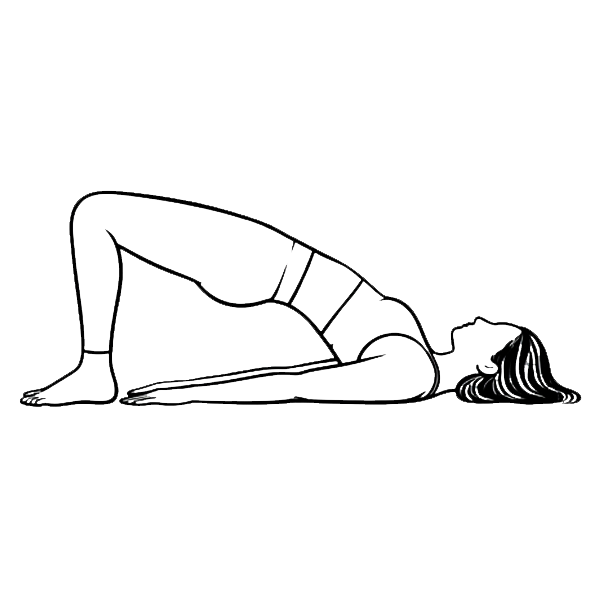
setu bandha sarvangasana
Pose family
Backbend / Supine Strength
Body focus
Gluteus maximus; hamstrings; spinal extensors; hip flexors; chest and shoulders
The Story
Rama's Bridge to Lanka
Setu means bridge. In the Ramayana, Sita is held across the sea in Lanka and Rama’s companions face an impossible distance. Hanuman can leap it, but everyone else cannot. So they build. Stone by stone, effort by effort, a crossing appears where none existed before. That is the beautiful thing about a bridge: it does not remove the distance between two shores; it makes relationship possible across it. Bridge Pose does the same with the body. Feet and shoulders remain on the earth while the center rises between them. What seemed separated becomes one continuous span. Not every distance is crossed in a single heroic leap. Sometimes the way forward is simply to build the next piece well enough to stand on.
The Body
Bridge Pose is driven by hip extension and spinal extension. The gluteus maximus and hamstrings lift the pelvis, while the erector spinae and quadratus lumborum contribute to the arch of the spine. The inner thighs help keep the femurs organized instead of allowing the knees to fall apart.
At the front of the body, the hip flexors, rectus abdominis, chest, and anterior shoulders lengthen. When the arms are straight and the hands clasp beneath the body, the triceps and shoulder position help create a stable upper-body base while the chest moves toward the chin without loading the neck.
Instructor Anatomy
Primary muscles
Gluteus maximus; hamstrings; erector spinae; quadratus lumborum
Stabilizers / secondary
Hip adductors; triceps; scapular stabilizers; deep trunk stabilizers
Joint actions
Hip extension; spinal extension; knee flexion; shoulder extension and scapular retraction
Anatomy cue
Keep thighs parallel
Instructor Notes
Press feet; Lift hips