
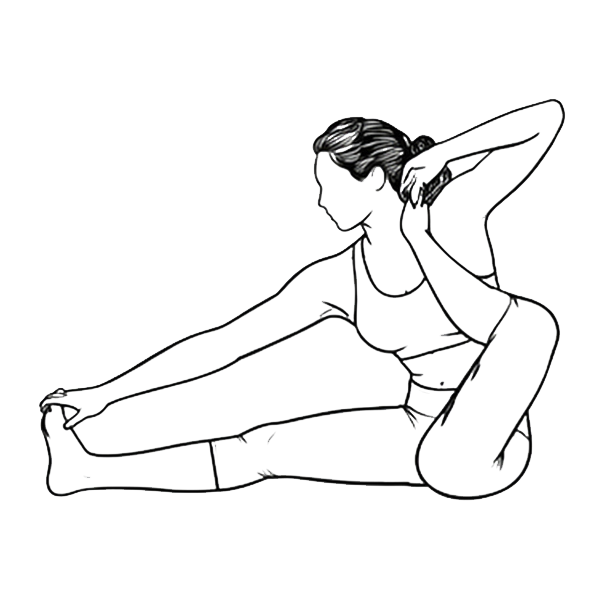
Akarna Dhanurasana
Pose family
Seated / Hip Opening / Forward Reach
Body focus
Hips; hamstrings; adductors; shoulders; arms; spinal length
The Story
The Bow at the Ear
The name Akarna Dhanurasana is remarkably literal: toward the ear, bow, posture. Early hatha descriptions tell the practitioner to draw one foot toward the ear as though pulling a bowstring while the opposite leg remains long. The modern pose therefore carries a strong archer image without needing invented symbolism. Indian epic literature is full of bows and tests of disciplined aim, but the most useful teaching image is immediate: a bow works because tension is directed, not random. Sit tall, keep the long leg alive, and draw the bent leg toward the ear without collapsing the spine. The pose becomes a practice of focus—strength and mobility organized around a clear line.
The Body
Akarna Dhanurasana places one hip in deep flexion with external rotation and the knee flexed while the opposite leg remains extended on the floor. Iliopsoas, sartorius, and other hip flexors organize the lifted thigh; the deep external rotators help position the femur. The straight-leg quadriceps maintain knee extension while the hamstrings lengthen. The arms create traction through elbow flexion and shoulder stabilization, but the movement should come primarily from hip mobility rather than pulling aggressively with the arms. Erector spinae and deep abdominal muscles keep the torso tall so the pelvis can remain organized instead of rolling backward.
Instructor Anatomy
Primary muscles
Iliopsoas; sartorius; quadriceps; biceps brachii
Stabilizers / secondary
Deep hip external rotators; spinal extensors; deep abdominals; scapular stabilizers
Joint actions
Lifted hip flexion/external rotation; knee flexion; opposite knee extension; elbow flexion; axial spinal extension
Anatomy cue
Sit tall; draw foot toward ear
Physiology / nervous system
The posture combines strong sensory input from the hips and hamstrings with sustained concentration and upright trunk control.
Instructor Notes
Sit tall; Keep long leg active; Draw from the hip rather than yanking with the arms