
Dekasana
Pose family
Standing / Single-Leg Balance / Hip Hinge
Body focus
Standing foot and ankle; quadriceps; gluteals; hamstrings; spinal extensors; core; shoulders; scapular stabilizers
The Story
The Body Takes Flight
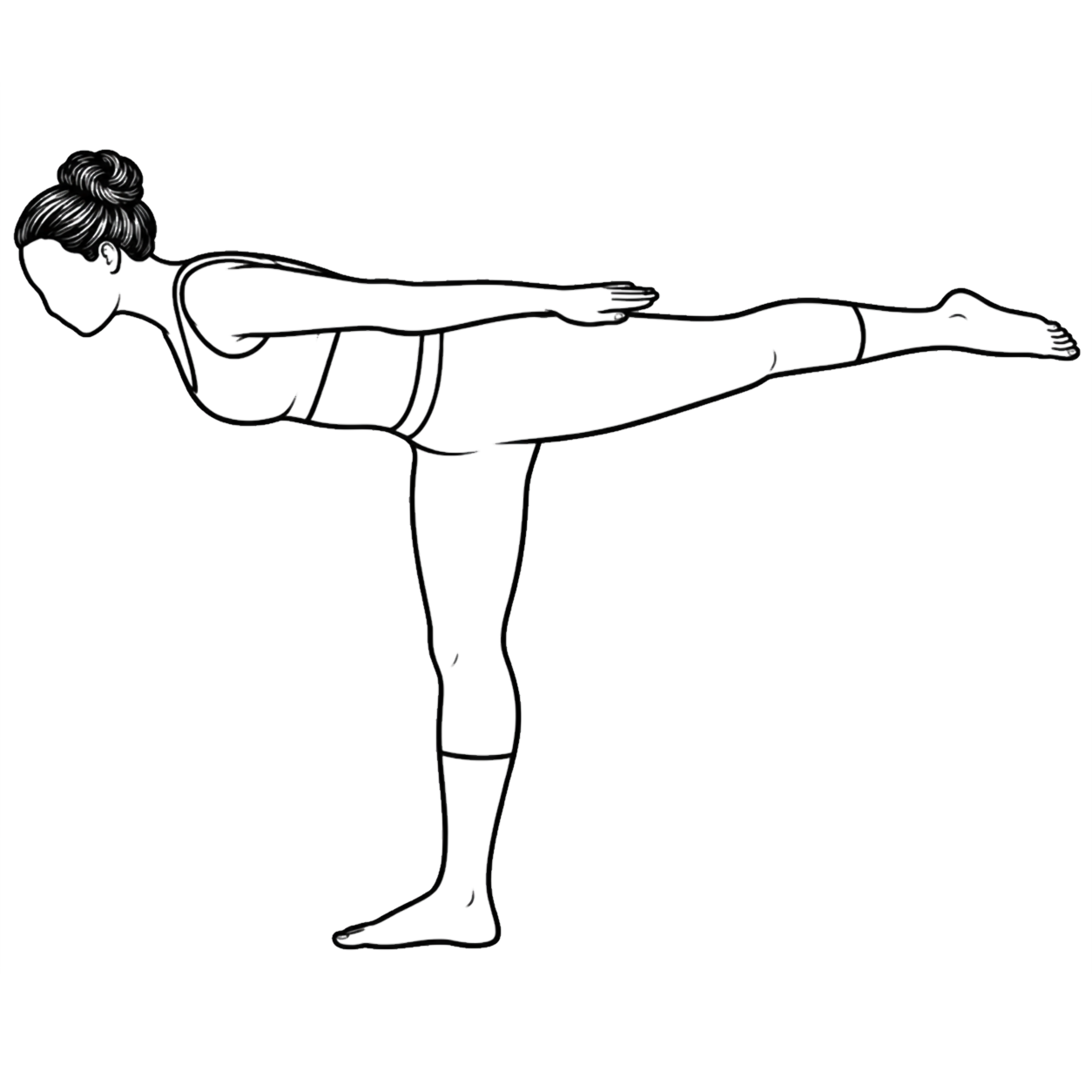
Dekasana, Airplane Pose, is a modern standing balance rather than a claim of an ancient named asana. Its identity is clear in the body: one foot becomes the runway, the torso and lifted leg lengthen almost parallel to the floor, and the arms sweep back beside the body instead of reaching forward. That arm position is not a trivial styling change. Bringing the arms behind the torso shortens the forward lever compared with a long-arm Warrior III and moves some body mass back toward the standing hip. Many practitioners therefore experience Airplane as a distinct balance problem—less about reaching forward and more about creating one long, quiet line from crown to heel while the arms become part of the flight. Keep the standing foot awake, the pelvis organized, and the back leg active. The airplane stays aloft because the whole structure participates.
The Body
Airplane is a single-leg hip-hinge balance with active posterior-chain work. The standing-leg quadriceps maintain knee extension while gluteus medius and the deep hip stabilizers control the pelvis. Intrinsic foot muscles, tibialis posterior, the fibularis muscles, soleus, and gastrocnemius make continuous corrections at the ankle as the center of mass shifts over a very small base of support. The lifted leg is driven into hip extension by gluteus maximus and the hamstrings, while the adductors and lateral hip muscles help keep the pelvis from rolling open.
The erector spinae, multifidus, transverse abdominis, and obliques organize the torso as it hinges forward. With the arms swept behind the body, the shoulders move into extension rather than the shoulder flexion of a forward-reaching Warrior III. Posterior deltoid, latissimus dorsi, the long head of triceps, rhomboids, and lower trapezius contribute to the backward reach and scapular organization. The changed arm lever also changes the balance demand, which is why Airplane can feel materially different even when the standing leg and lifted leg share geometry with other one-leg hinges.
Instructor Anatomy
Primary muscles
Standing-leg quadriceps; gluteus medius; lifted-leg gluteus maximus and hamstrings; erector spinae
Stabilizers / secondary
Intrinsic foot muscles; soleus and gastrocnemius; tibialis posterior; fibularis muscles; deep abdominals; multifidus; rhomboids; lower trapezius
Joint actions
Standing ankle stabilization and knee extension; hip hinge; lifted-hip extension; trunk stabilization; shoulder extension; scapular retraction/depression
Anatomy cue
Level pelvis; sweep arms back; reach through lifted heel
Physiology / nervous system
Single-leg stance narrows the base of support, while the rearward arm position changes the body's lever system and can reduce the forward balance demand compared with long forward-reaching arms.
Instructor Notes
Root standing foot; Level pelvis; Reach crown and heel apart; Sweep arms back; Keep back leg active; Gaze down and forward