Pose of the Day
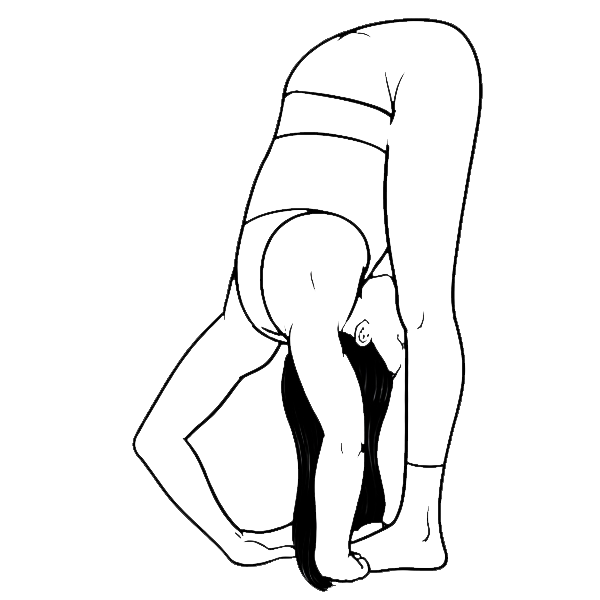
Hand-to-Big-Toe Forward Fold
padangusthasana
Explore Padangusthasana as a standing forward fold where the toe grip helps organize spinal length, hamstring stretch, active…
Move. Breathe. Be.

Walk into almost any contemporary vinyasa class in the United States and much of what happens will feel familiar: Sun Salutations begin the practice, movement follows the breath, Chaturanga leads to Upward-Facing Dog and Downward-Facing Dog, standing postures build progressively, the body becomes warm through continuous movement, and the practice eventually descends toward quieter postures and rest. That language of movement has become so common that it can seem simply to be “yoga.” Much of…

Ask what the word yoga means and the most common English answer is union. It is not a bad answer. It is simply too small. The Sanskrit word carries an old sense of joining, yoking or harnessing, and this is the origin of the familiar translation. But when yoga is actually encountered in texts such as the Bhagavad Gita, “union” quickly becomes inadequate. The Gita speaks of karma-yoga, the yoga of action; of knowledge and…

Imagine placing two books beside one another. Place The Ten Books on Architecture by Vitruvius beside the Yoga Sūtras of Patañjali and they initially seem to belong to entirely different conversations. Vitruvius wants to know how a wall should stand, where a city should be placed, how water should move, how a theater should carry sound, what proportions make a temple beautiful and what an architect needs to know before accepting responsibility for the work.…

Few ancient yoga texts are quoted more often than the Yoga Sūtras of Patañjali. Few are easier to quote without understanding. The book is short. Extremely short. The commonly received text contains 195 compact statements, or sūtras, totaling only around 1,200 Sanskrit words. You could print the basic Sanskrit text in surprisingly little space. Understanding it is another matter. What Is a Sūtra? The word sūtra literally suggests a thread. In ancient Indian intellectual traditions,…

Before reading the Yoga Sūtras of Patañjali, it helps to understand Sāṃkhya. Otherwise Patañjali can sometimes sound as though he begins his book halfway through a conversation. In a sense, he does. Many of the ideas behind classical Yoga were already part of a much larger philosophical discussion. Sāṃkhya supplied much of the framework Patañjali’s Yoga would use to explain the mind, the body, consciousness and liberation. The system can seem complicated at first. At…

The Bhagavad Gītā begins in a strange place for a book that would become one of the most influential texts in the history of yoga. A battlefield. Two armies are facing one another. Warriors are preparing to fight. Families, teachers, friends and relatives stand on opposite sides. And one of the greatest warriors on the field decides he cannot do it. His name is Arjuna. The person driving his chariot is Krishna. What follows is…

There is a simple version of yoga history that goes something like this: First came the Vedas. Then the Upanishads. Then Hindu philosophers developed yoga. The real history is considerably messier. Fortunately, it is also much more interesting. During the middle of the first millennium BCE, northern India was experiencing enormous social change. Cities were growing again after a long period in which large urban centers had been absent from much of the region. Trade…

The Upanishads are often spoken about as though they were one ancient book. They are not. They are a collection of texts composed at different times, by different people, in different Vedic schools. The oldest principal Upanishads were probably composed during the first millennium BCE, with important layers appearing over several centuries. That long development matters because there is no single “Upanishadic philosophy” waiting neatly inside them. They argue, speculate, tell stories, ask questions and…

If we want to understand where yoga came from, the Vedas are an obvious place to begin. But they are also a good place to clear up one common misconception. The Vedas are not ancient yoga manuals. They come from a world considerably older than the yoga systems most people recognize today. There are no flowing posture sequences, no eight-limbed path, no studio class and no ancient version of a yoga mat hidden between the…

Yoga is difficult to define because it has never been only one thing. Today, the word often brings to mind a room filled with mats and people moving through physical postures. That is certainly yoga, but it represents only one part of a much larger tradition that developed over thousands of years. Yoga has been philosophy, meditation, disciplined physical practice, spiritual inquiry, breathwork, ethics and a method for understanding the relationship between the body and…
Pose of the Day
padangusthasana
Explore Padangusthasana as a standing forward fold where the toe grip helps organize spinal length, hamstring stretch, active…
Daily Pose
A pose, a short read, and something worth knowing—once a day.