
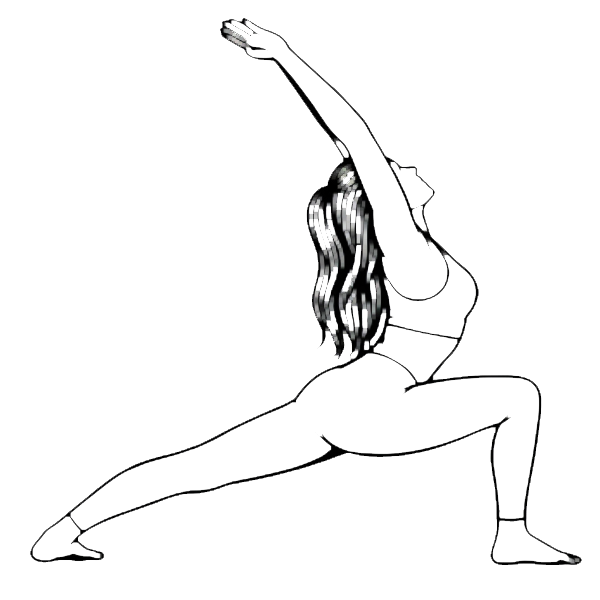
Virabhadrasana I
Pose family
Standing Strength / Backbend
Body focus
Quadriceps; gluteals; hip flexors; spinal extensors; shoulders and arms
The Story
Virabhadra Rises
Shiva’s grief after Sati’s death becomes so fierce that he tears a lock of hair from his head and casts it to the earth. From that force rises Virabhadra, the warrior. Warrior I carries the first moment of that image: feet grounded, body rising, arms reaching into the space above. It is tempting to reduce the story to aggression, but grief is underneath it. Human beings know this transformation—pain becoming action, loss becoming force. The question is what we do with the force once it has arrived. Rise. Feel it. Give it direction.
The Body
Warrior I combines front-leg hip and knee flexion with strong extension through the back leg and an upright, slightly extended torso. The front quadriceps and hip muscles support the bent knee while the back-leg gluteals, adductors, and lower-leg muscles create a long line of force into the rear foot.
The spinal extensors help lift the chest while the abdominals organize the ribs and pelvis. With the arms overhead, the deltoids, triceps, serratus anterior, trapezius, and rotator-cuff muscles coordinate shoulder flexion and upward rotation. The posture is therefore a full-body opposition: descend through the legs while the torso and arms rise.
Instructor Anatomy
Primary muscles
Front-leg quadriceps; gluteus maximus; erector spinae; deltoids; triceps
Stabilizers / secondary
Gluteus medius/minimus; adductors; serratus anterior; trapezius; rotator cuff; abdominals
Joint actions
Front hip/knee flexion; rear hip extension; spinal extension; shoulder flexion/upward rotation
Anatomy cue
Lift chest
Instructor Notes
Root feet; Hips forward