
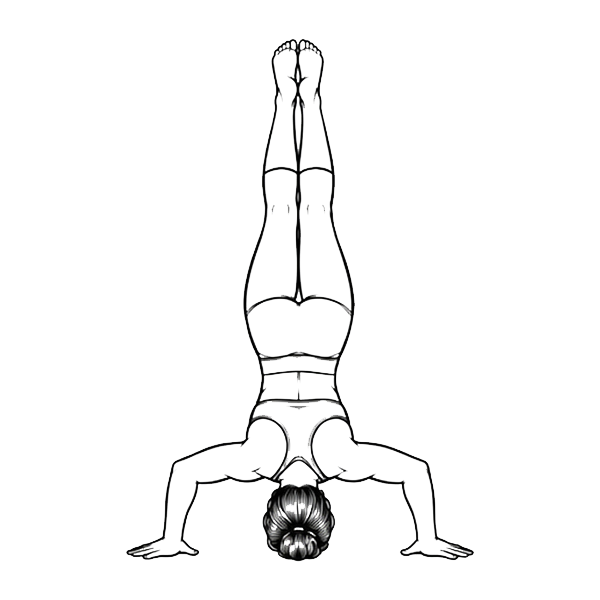
Mukta Hasta Shirshasana A
Pose family
Headstand / Tripod Inversion
Body focus
Shoulders; triceps; upper back; core; hips; legs; inversion balance
The Story
A Three-Point Foundation
Mukta Hasta Shirshasana is a free-hand headstand variation; the English name Tripod Headstand describes its base exactly. Two hands and the head create three points of contact. The geometry matters because the pose is not simply “standing on the head.” The hands share the work, the shoulders stay active, and the body stacks upward from a broad triangular foundation. The story is therefore architectural: before height, establish the base. A stable tripod can carry surprising vertical load when each point is placed deliberately and the structure above it stays organized.
The Body
Tripod Headstand uses the crown of the head and both hands as a three-point base. The wrists are extended and elbows flex to roughly 90 degrees while triceps, serratus anterior, and the rotator cuff stabilize the shoulder girdle. Deep abdominal muscles stack the pelvis over the rib cage and help prevent excessive lumbar extension. Gluteals, quadriceps, and adductors organize the legs into a vertical line. The cervical spine carries some compressive load, so active pressure through the hands and shoulders is essential. The pose should feel like shared support rather than the full body collapsing onto the head.
Instructor Anatomy
Primary muscles
Triceps; serratus anterior; rectus abdominis; quadriceps
Stabilizers / secondary
Rotator cuff; transverse abdominis; hip adductors; spinal stabilizers; wrist/finger muscles
Joint actions
Wrist extension; elbow flexion; shoulder stabilization; hip and knee extension; axial trunk stabilization
Anatomy cue
Share load through hands and head
Physiology / nervous system
A three-point base distributes inversion load across the hands and head while the trunk maintains vertical alignment.
Instructor Notes
Build an even tripod; Press through hands; Keep elbows over wrists; Stack pelvis before straightening legs