
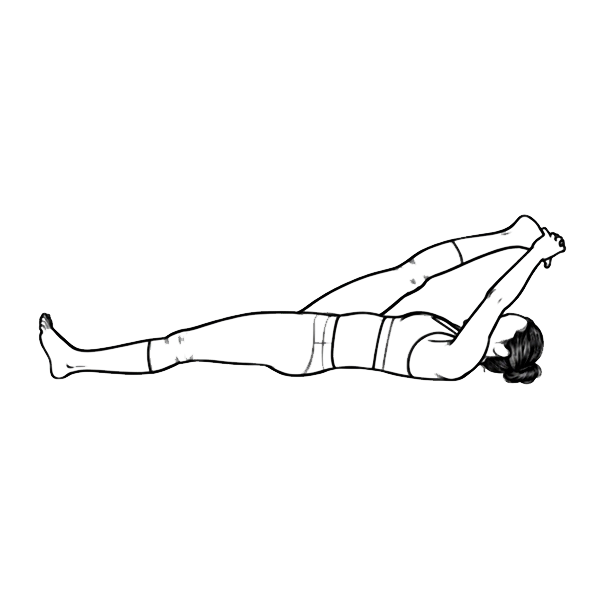
Supta Trivikramasana
Pose family
Supine Split / Deep Hamstring Opening
Body focus
Hamstrings; calves; hips; quadriceps; pelvic stability; shoulders
The Story
Three Steps, One Reach
Trivikrama is a name of Vishnu connected with the story of Vamana, the small figure who expands and crosses the worlds in three immense steps. Supta Trivikramasana brings that “three-stride” name into a reclining split: one leg stays long along the earth while the other travels toward and beyond the head. The myth is useful here because it turns range of motion into a question of scale and discernment. Vast reach does not have to mean force. The body remains grounded while one leg explores extraordinary distance. The practice becomes patient expansion—keep the pelvis honest, the breath steady, and let the stride grow only as far as control remains.
The Body
Supine Foot to Head places the lifted hip in very deep flexion with the knee extended, creating an intense lengthening demand on the hamstrings and calf. The opposite leg remains long on the floor, where quadriceps activity and hip extension help stabilize the pelvis. The lifted-leg quadriceps maintain knee extension while the hip flexors help control the leg’s position. The hands hold the foot, but the shoulders and elbows should not turn the pose into an aggressive pull. Deep abdominal and pelvic stabilizers keep the pelvis from rolling or hiking as the leg approaches the head. The neck remains relaxed on the floor.
Instructor Anatomy
Primary muscles
Hamstrings; gastrocnemius; quadriceps; iliopsoas
Stabilizers / secondary
Deep abdominals; gluteus maximus of the grounded leg; hip adductors; rotator cuff
Joint actions
Lifted hip flexion; lifted knee extension; grounded hip extension; shoulder flexion/elbow flexion for the hold
Anatomy cue
Keep pelvis heavy; lengthen both legs
Physiology / nervous system
A supine base reduces balance demand so attention can stay on controlled hamstring length and pelvic position.
Instructor Notes
Keep pelvis heavy; Keep both knees long; Draw leg from the hip; Do not pull the head toward the foot