
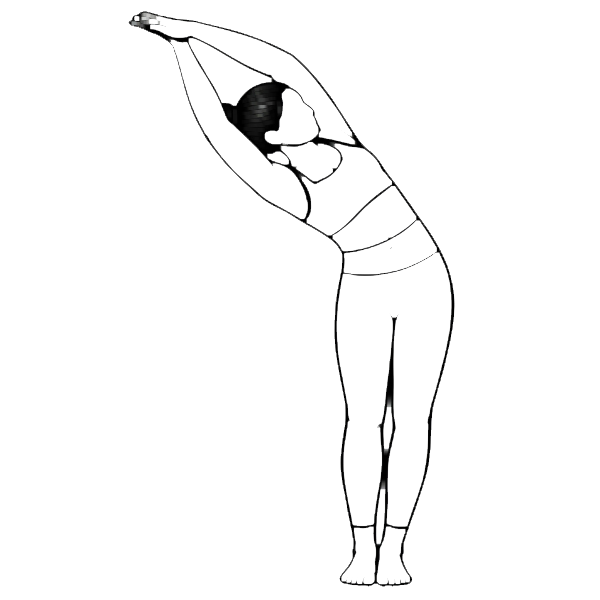
eka hasta parsvasana
Pose family
Standing / Lateral Bend
Body focus
Obliques; quadratus lumborum; intercostals; latissimus dorsi; shoulders; hips
The Story
Make Room Between the Ribs
Reach one arm overhead and bend to the side. Such a small change suddenly exposes a part of the body that ordinary life barely visits. One side shortens; the other becomes an open arc. Breathe into that arc. Imagine the ribs separating enough to make room for the breath rather than forcing the body farther sideways. A side bend is a reminder that space can be created without going anywhere. Sometimes the room you need is already inside the shape you are making.
The Body
The spine moves into lateral flexion while the opposite-side quadratus lumborum, obliques, intercostals, and latissimus dorsi lengthen. Muscles on the shortening side contract to control the bend. The pelvis and legs stabilize so the movement occurs through the trunk rather than simply shifting the hips sideways. With the arms overhead, shoulder flexion and scapular upward rotation add additional length through the side body. The rib cage changes shape asymmetrically, which can make breathing feel noticeably different on the open side.
Instructor Anatomy
Primary muscles
Obliques and quadratus lumborum on the shortening side; shoulder flexors
Stabilizers / secondary
Intercostals; latissimus dorsi; gluteus medius; deep abdominals; spinal stabilizers
Joint actions
Spinal lateral flexion; shoulder flexion; pelvic stabilization
Anatomy cue
Bend sideways
Physiology / nervous system
Side bending changes rib-cage geometry and can make inhalation feel more available on the lengthened side.
Instructor Notes
Root feet; Reach up