
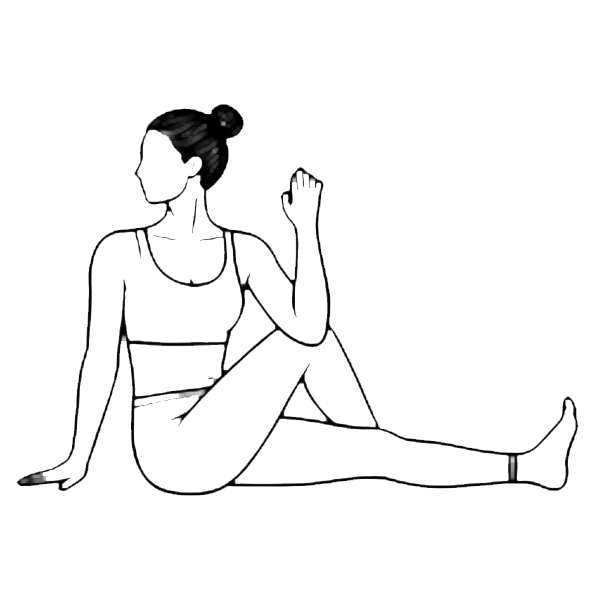
Ardha Matsyendrasana
Pose family
Seated Twist
Body focus
Obliques; multifidus; rotatores; thoracic spine; hips
The Story
Turn Around the Center
A seated spinal twist is one of yoga’s simplest demonstrations that rotation works best around length. If the spine collapses first, the twist becomes small and compressed. If the body grows upward first, the ribs have room to turn. This version lives in the same family as Ardha Matsyendrasana, the pose associated with Matsyendra—the legendary fish who listened so completely to Shiva’s teaching that he was transformed. You do not need the full traditional leg position to use the lesson. Sit well. Breathe in and get taller. Breathe out and turn without yanking yourself farther than the ribs and spine are ready to go. Attention, not maximum range, is the useful part.
The Body
Spinal Twist is an axial rotation from a seated base. The internal and external obliques create and control rotation while multifidus and the rotatores provide segmental support. Most visible rotation should be distributed through the thoracic spine rather than forced through the lumbar region. The pelvis may participate slightly depending on the variation; rigidly pinning it can sometimes shift stress into the sacroiliac area. The cervical spine follows the thorax rather than leading the movement. A long upright trunk before rotation generally improves both range and comfort.
Instructor Anatomy
Primary muscles
Internal and external obliques; multifidus; rotatores
Stabilizers / secondary
Erector spinae; transverse abdominis; pelvic stabilizers; deep cervical stabilizers
Joint actions
Axial spinal rotation; variable hip positioning; cervical rotation following thoracic rotation
Anatomy cue
Get taller before you turn
Instructor Notes
Inhale taller; exhale to rotate through the ribs; let the head follow the chest