
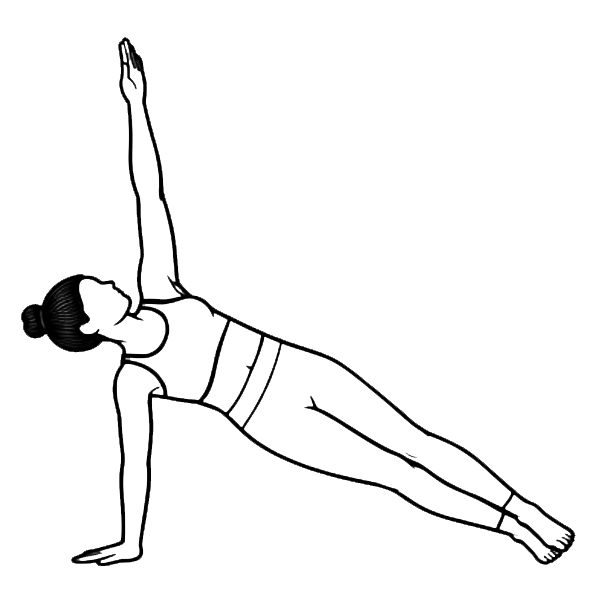
vasisthasana
Pose family
Arm Balance / Side Plank
Body focus
Shoulder girdle; triceps; obliques; gluteus medius; lateral hip; legs; wrists
The Story
The Sage Who Needed Nothing
Vasistha is remembered as a great sage, counselor to kings, and teacher of Rama. Stories give him extraordinary power, even a wish-granting cow, yet his deeper authority comes from not being owned by what he possesses. Side Plank has something of that exposed simplicity. One hand, the edge of the feet, the body lifted into open space. There is nowhere to hide excess effort. Push the earth away and let the whole side body participate. Strength becomes cleaner when it is not trying to prove anything.
The Body
The supporting shoulder bears substantial load through an extended elbow. Triceps, serratus anterior, rotator cuff, and latissimus dorsi help stabilize the upper body. The obliques and quadratus lumborum resist the pelvis sagging toward the floor, while gluteus medius and the lateral hip musculature keep the legs and pelvis stacked. The feet are not decorative; active legs reduce the burden on the wrist and shoulder. Balance requires continuous coordination through a narrow lateral base.
Instructor Anatomy
Primary muscles
Triceps; serratus anterior; obliques; gluteus medius; latissimus dorsi
Stabilizers / secondary
Rotator cuff; quadratus lumborum; transverse abdominis; foot/ankle stabilizers
Joint actions
Shoulder stabilization; elbow extension; lateral trunk stabilization; hip abduction; ankle stabilization
Anatomy cue
Lift lower waist
Physiology / nervous system
Side Plank is a demanding closed-chain shoulder and lateral-core exercise that develops strength and balance.
Instructor Notes
Push floor; Hips up