
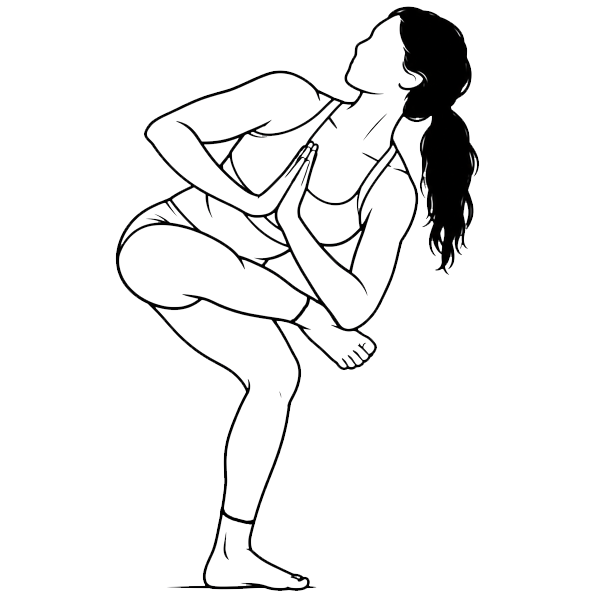
Parivrtta Eka Pada Utkatasana
Pose family
Standing / Figure Four / Twist / Balance
Body focus
Standing quadriceps and gluteals; crossed-leg outer hip; obliques; thoracic rotation; foot and ankle stabilizers
The Story
Turn Around the Figure Four
Revolved Standing Figure Four adds rotation to the one-legged fierce shape. The Sanskrit label Parivrtta Eka Pada Utkatasana is a modern descriptive name: revolved, one-legged, fierce pose. One foot roots, the crossed hip opens, and the rib cage turns while the base tries to stay quiet. That combination makes the pose less about how far you can twist and more about whether you can keep the standing knee, pelvis, breath, and gaze organized while you turn. Lengthen first, then rotate. A smaller twist over a steady foot is a more complete pose than a large twist built on a collapsing base.
The Body
The standing leg remains in hip and knee flexion with active ankle and foot stabilization, while the crossed hip stays flexed, abducted, and externally rotated in the figure-four position. The internal and external obliques contribute to trunk rotation, with multifidus and the deep abdominal wall helping control the spine. Most of the visible rotation should come through the thoracic spine and rib cage rather than being forced through the lumbar area. Gluteus medius, the calf complex, tibialis posterior, fibularis muscles, and intrinsic foot muscles continuously manage the reduced base of support. The crossed foot stays dorsiflexed and the standing knee tracks with the toes as the torso lengthens and turns.
Instructor Anatomy
Primary muscles
Standing quadriceps and gluteus maximus; internal and external obliques
Stabilizers / secondary
Gluteus medius; transverse abdominis; multifidus; calf complex; tibialis posterior; fibularis muscles; intrinsic foot muscles; deep hip rotators
Joint actions
Standing hip/knee flexion with ankle stabilization; crossed hip flexion, abduction and external rotation; crossed knee flexion; thoracic rotation; trunk stabilization
Anatomy cue
Lengthen first; rotate the ribs over a steady base
Physiology / nervous system
The twist adds rotational core demand to an already reduced base of support, increasing coordination requirements without needing a deeper squat or a forced range of spinal rotation.
Instructor Notes
Flex crossed foot; Track standing knee; Lengthen first; Rotate ribs; Keep pelvis steady