
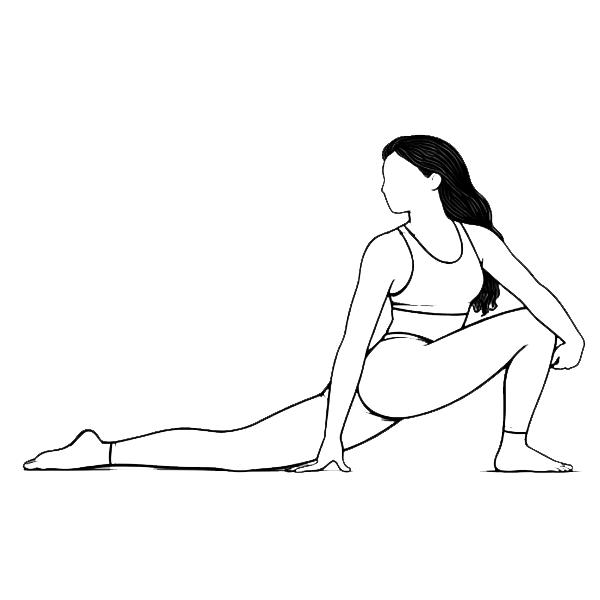
Parivrtta Anjaneyasana
Pose family
Low Lunge / Twist Variation
Body focus
Quadriceps; gluteals; hip flexors; obliques; thoracic spine; shoulder girdle
The Story
Turn Without Losing the Ground
This second Revolved Lunge variation keeps the body lower and makes the twist feel more integrated with the front leg. The visual temptation is to look at the shoulders, but the quality of the pose is usually decided lower down: front foot stable, knee tracking, back leg long or back knee grounded, pelvis controlled. Once that base is dependable, the trunk can rotate and the arms can open into whatever version fits the sequence. Treat it as a conversation between locomotion and rotation. The legs still say ‘lunge.’ The ribs say ‘turn.’ Neither has to overpower the other.
The Body
This variation uses the same basic lower-body mechanics as Parivrtta Anjaneyasana: front hip and knee flexion, back-hip extension, and a strong need for frontal-plane pelvic control. The obliques and deep spinal rotators create the twist while the gluteus medius and front-leg musculature keep the knee and pelvis organized. Depending on arm placement, the shoulders may abduct, extend, or bear partial weight. A shorter stance or back knee on the floor reduces balance and strength demands and can make thoracic rotation easier to isolate.
Instructor Anatomy
Primary muscles
Front quadriceps and gluteals; internal and external obliques; back-leg hip flexors in stretch
Stabilizers / secondary
Gluteus medius; multifidus; transverse abdominis; foot and ankle stabilizers
Joint actions
Front-hip and knee flexion; back-hip extension; thoracic axial rotation; variable shoulder abduction/extension
Anatomy cue
Keep the legs unmistakably in a lunge while the ribs rotate
Instructor Notes
Keep front knee centered over the foot; shorten the stance or lower the back knee to clean up the twist