
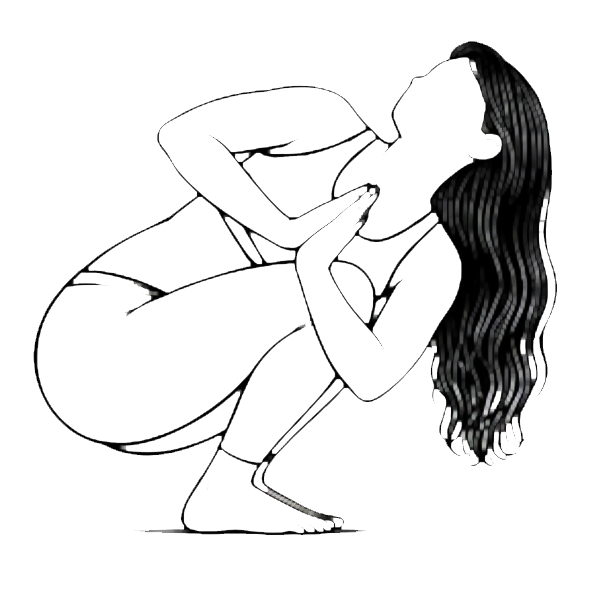
panvritta utkatasana
Pose family
Standing / Twist / Strength
Body focus
Quadriceps; gluteals; trunk rotators; thoracic rotation; pelvic stability
The Story
Root to Rise
The legs bend deeply as though sitting back into the earth, while the spine rises and turns. Revolved Chair is built on a simple paradox: descend in order to lift; root in order to rotate. If the foundation becomes frantic, the twist becomes a fight. Let the feet become heavy first. Lengthen the spine as though the crown were being drawn upward. Then turn around that long axis. A tree can twist in wind because it is rooted. The same idea works surprisingly well in a human body.
The Body
The knees and hips remain flexed as in Chair Pose, loading the quadriceps and gluteals while the trunk rotates. Much of healthy spinal rotation should be distributed through the thoracic region rather than forced into the lumbar spine, whose facet orientation permits less rotation. The obliques, multifidus, rotatores, and other deep spinal muscles coordinate the twist while the legs and pelvis resist unwanted shifting. Using the arm against the thigh can add leverage, which makes stabilization more important, not less.
Instructor Anatomy
Primary muscles
Quadriceps; gluteus maximus; internal/external obliques
Stabilizers / secondary
Multifidus; rotatores; transverse abdominis; gluteus medius
Joint actions
Hip and knee flexion; thoracic rotation; spinal axial extension
Anatomy cue
Keep knees aligned
Physiology / nervous system
Twisting changes pressure within the trunk and temporarily compresses soft tissues while the legs maintain a loaded squat.
Instructor Notes
Sit low; Rotate ribs