
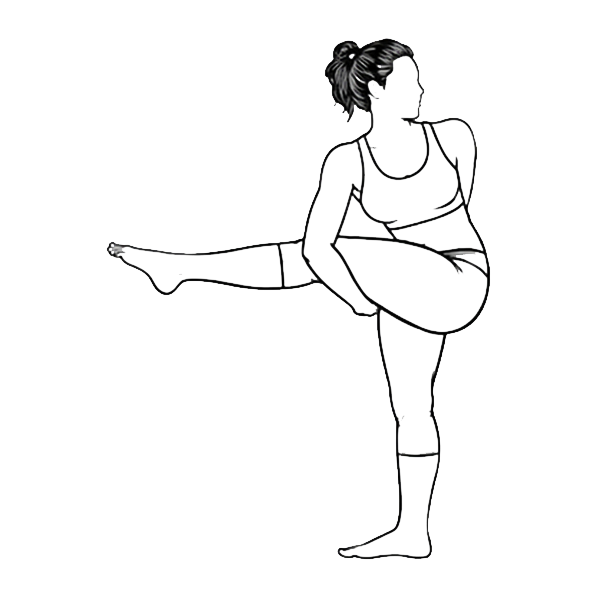
Parivritta Svarga Dvijasana
Pose family
Standing Balance / Bind / Twist
Body focus
Standing-leg stability; lifted hip; hamstrings; shoulders; bind; thoracic rotation
The Story
Paradise with a Turn
Svarga can mean heaven or paradise, and the familiar English name Bird of Paradise evokes the extravagant flower whose long, unusual form seems almost airborne. Parivritta adds rotation. This is a modern advanced balance rather than an ancient mythic posture, so the story is best kept in the visible image: a bound body rises from the floor, stands on one leg, opens the lifted leg, and then turns the torso without losing the bind. The result looks improbable until the separate pieces are understood. The practice is less about spectacle than integration—balance, mobility, strength, and orientation all working at once.
The Body
Revolved Bird of Paradise combines single-leg balance with deep hip flexion and abduction, knee extension of the lifted leg, a shoulder bind, and thoracic rotation. The standing quadriceps and gluteus medius maintain the base while intrinsic foot and ankle muscles make continuous balance corrections. The lifted-leg hamstrings and adductors must allow range while the hip flexors and quadriceps organize the leg. Obliques and spinal rotators turn the rib cage. The bind demands shoulder extension, internal rotation, and scapular control. Because several mobility requirements converge at once, the pose is most stable when rotation occurs through the thoracic spine rather than by twisting the knee or forcing the shoulder.
Instructor Anatomy
Primary muscles
Quadriceps; gluteus medius; hip flexors; obliques
Stabilizers / secondary
Intrinsic foot muscles; deep abdominals; spinal rotators; rotator cuff; scapular stabilizers
Joint actions
Standing knee extension; lifted hip flexion and abduction; lifted knee extension; thoracic rotation; shoulder extension/internal rotation
Anatomy cue
Stand tall; rotate above pelvis
Physiology / nervous system
The pose requires continuous proprioceptive correction while several joints sustain large but controlled ranges of motion.
Instructor Notes
Root standing foot; Keep pelvis organized; Twist above the pelvis; Do not force the bind