
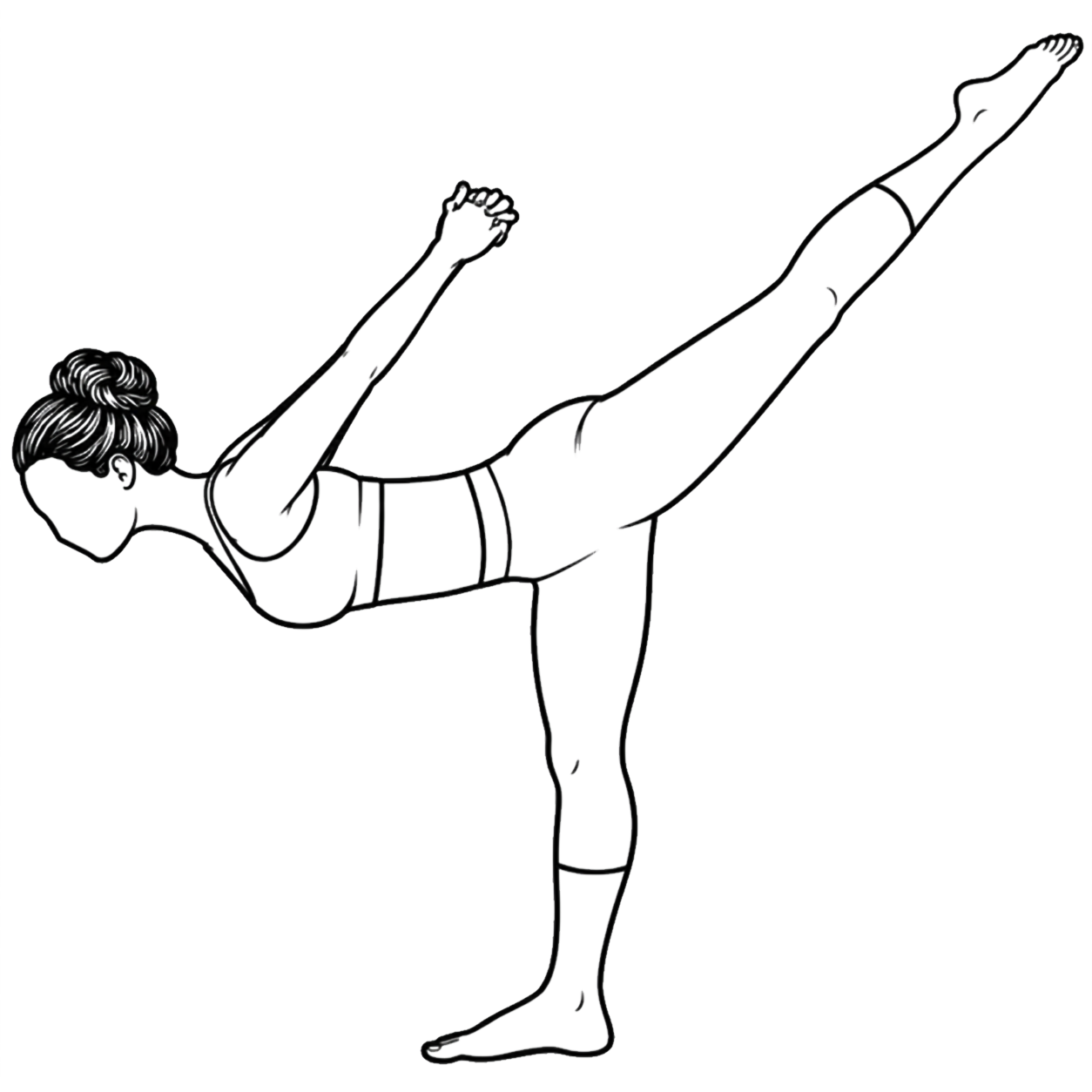
No standardized Sanskrit name (modern standing balance)
Pose family
Standing / Single-Leg Balance / High Hip Extension / Shoulder Bind
Body focus
Standing foot and ankle; quadriceps; gluteals; hamstrings; spinal extensors; core; shoulders; upper back; scapular stabilizers
The Story
The Swan Rises
One-Legged Swan is used here as the specific name for this standing balance: one leg roots into the floor, the torso hinges forward, the opposite leg rises high and stays long, and the hands bind behind the back with the joined arms actively lifted away from the spine. This is a modern working pose name, not a claim that this exact geometry has a standardized classical Sanskrit title. The image is the useful part. A swan looks effortless on the surface while producing constant work underneath; this balance has the same contradiction. The standing foot makes rapid corrections, the lifted leg keeps reaching upward, and the bound arms pull together and rise behind the body. That arm tension is functional, not decorative: it gives the upper body a strong opposing line and can make the entire shape feel more integrated. The practice is to create tension without becoming rigid—root down, lift back, bind, breathe, and let the whole body solve the balance together.
The Body
One-Legged Swan combines an advanced single-leg hinge with a high lifted-leg hip extension and an active shoulder bind. The standing quadriceps stabilize the knee while gluteus medius, adductors, deep hip rotators, and the foot-and-ankle complex keep the pelvis and center of mass organized over one foot. As the rear leg lifts above hip height, gluteus maximus and the hamstrings produce hip extension while the standing-leg hamstrings lengthen under load as the torso hinges forward.
The trunk must remain long rather than collapse: erector spinae and multifidus resist excessive spinal flexion while the abdominal wall controls the ribs and pelvis. Behind the body, interlaced hands place both shoulders into extension with the scapulae retracting and depressing as the joined arms lift. Posterior deltoid, latissimus dorsi, the long head of triceps, rhomboids, and lower trapezius contribute to that action. The bound arms also shift mass behind the torso and create strong isometric tension and proprioceptive feedback. For some experienced practitioners, that tension becomes part of the balancing strategy: the grounded foot pushes down while the lifted leg and bound arms rise in opposite directions.
Instructor Anatomy
Primary muscles
Standing-leg quadriceps and gluteus medius; lifted-leg gluteus maximus and hamstrings; erector spinae; posterior deltoid
Stabilizers / secondary
Intrinsic foot muscles; calf complex; adductors; deep hip rotators; transverse abdominis; obliques; multifidus; rhomboids; lower trapezius; long head of triceps
Joint actions
Standing ankle stabilization and knee extension; hip hinge; high lifted-hip extension; trunk stabilization; bilateral shoulder extension; scapular retraction/depression; elbow extension
Anatomy cue
Root down; lift the back leg; bind the hands and actively lift the joined arms away from the spine
Physiology / nervous system
The arm bind changes mass distribution and adds isometric tension and proprioceptive feedback; experienced practitioners may use that organized tension as part of the balance strategy.
Instructor Notes
Root standing foot; Keep standing knee organized; Lift back leg high; Interlace hands; Lift bound arms 6–8 inches away from the back; Keep chest long; Breathe