
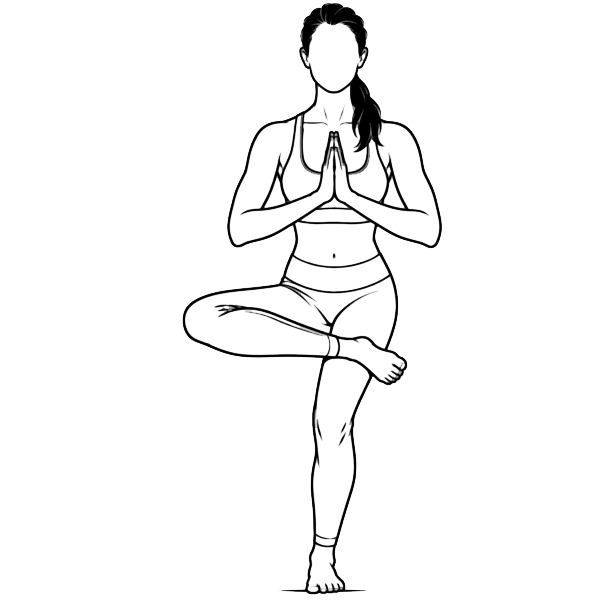
Eka Pada Utkatasana
Pose family
Standing / Figure Four / Single-Leg Balance
Body focus
Standing quadriceps and gluteals; foot and ankle stabilizers; crossed-leg outer hip; deep external rotators; core
The Story
The Fierce Figure Four
Eka Pada Utkatasana is the one-legged form of Fierce Pose, and in modern practice it is widely taught as Standing Figure Four or Standing Pigeon. Cross one ankle over the opposite thigh and suddenly the pose has two jobs: the standing leg becomes the chair while the crossed hip opens. The shape looks simple because the arms can stay quiet at the heart, but the base is constantly negotiating with gravity. Sit back without collapsing. Flex the crossed foot. Let the outer hip open without pushing the knee down. This is also the ground-level geometry that leads toward Flying Pigeon: first learn to hold the figure four with steadiness, then decide whether it ever needs to leave the floor.
The Body
The standing hip and knee flex as the pelvis sits back, with the quadriceps and gluteus maximus controlling the squat. Gluteus medius, the calf complex, tibialis posterior, fibularis muscles, and intrinsic foot muscles stabilize the single-leg base. The crossed leg moves into hip flexion, abduction, and external rotation while the knee remains flexed; keeping that foot dorsiflexed helps organize the ankle and knee. The deep abdominals and spinal stabilizers keep the ribs and pelvis from drifting as the torso inclines forward. The goal is not to force the crossed knee down, but to create the figure-four shape from the hip while the standing knee continues to track with the foot.
Instructor Anatomy
Primary muscles
Standing quadriceps and gluteus maximus; crossed-leg gluteals and deep hip external rotators
Stabilizers / secondary
Gluteus medius; soleus and gastrocnemius; tibialis posterior; fibularis muscles; intrinsic foot muscles; transverse abdominis; multifidus
Joint actions
Standing hip and knee flexion with ankle dorsiflexion/stabilization; crossed hip flexion, abduction and external rotation; crossed knee flexion; ankle dorsiflexion; trunk stabilization
Anatomy cue
Flex crossed foot; sit back through the standing hip
Physiology / nervous system
Single-leg support increases balance and proprioceptive demand while the crossed-leg figure four places a controlled external-rotation stretch through the outer hip.
Instructor Notes
Flex crossed foot; Ankle above knee; Sit hips back; Track standing knee; Keep spine long