
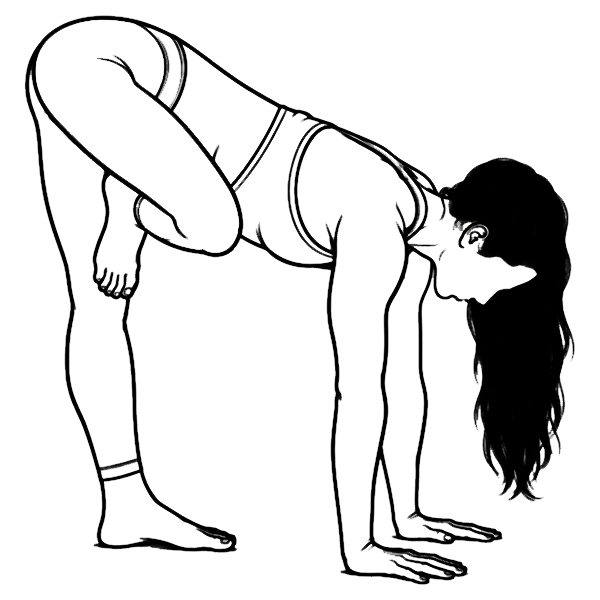
ardha baddha padmottanasana
Pose family
Standing / Balance / Forward Fold / Lotus
Body focus
Standing leg; hamstring; hip external rotation; ankle; knee protection; trunk
The Story
Ahimsa at the Knee
Half-Bound Lotus Forward Bend can become a lesson in non-harming faster than almost any pose. The body may want the beautiful final shape before the hip is ready to give it. The knee then becomes the place where ambition sends the bill. Ahimsa—non-harming—is easy to admire as philosophy and harder to practice when desire is involved. Here it becomes physical. Can you want the pose without forcing the pose? Can restraint be part of progress? There is dignity in stopping at the place where the body is telling the truth. A flower does not become more spiritual because you pry it open.
The Body
The standing leg supplies balance and knee stability while its hamstrings lengthen in the fold. The lifted leg requires substantial hip external rotation and flexion to enter Half Lotus. If that motion is unavailable at the hip, torque can be transferred into the knee, especially the medial structures. The ankle of the lotus leg also needs to remain organized rather than sickled. As the torso folds, the pelvis should rotate over the standing femur so the lumbar spine is not forced to create all the range.
Instructor Anatomy
Primary muscles
Standing quadriceps and gluteus medius; standing hamstrings under stretch; lotus-leg deep external rotators
Stabilizers / secondary
Foot intrinsics; calves; deep core; multifidus
Joint actions
Standing hip stabilization; lotus-leg hip flexion/external rotation; knee flexion; forward hip hinge
Anatomy cue
Protect knee
Physiology / nervous system
Single-leg balance increases proprioceptive demand while hip mobility absorbs rotational load through the lower body.
Instructor Notes
Open hip; Fold forward