
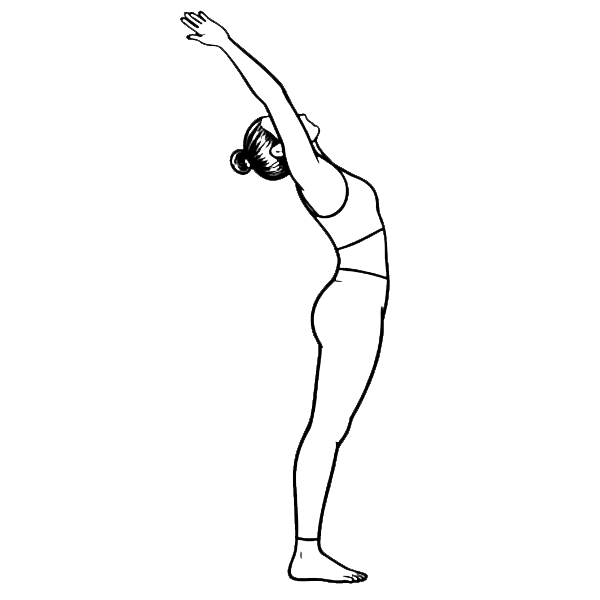
anuvittasana
Pose family
Standing / Gentle Backbend
Body focus
Spinal extensors; gluteals; quadriceps; hip flexors; abdominal wall; chest; shoulders
The Story
Look Up Without Leaving the Ground
A small standing backbend changes the world simply because the gaze changes. After looking down, forward, or inward, the chest rises and the sky comes into view. The trick is not to abandon the earth in order to look upward. Keep the feet heavy. Let the breastbone rise from a body that is still rooted. There is a useful human lesson in that: aspiration works better when it has a foundation. Reach toward what is above you without pretending you are no longer standing where you are.
The Body
The feet and legs create the base while the spinal extensors produce extension through the thoracic and lumbar spine. Gluteals and quadriceps stabilize the pelvis and lower body. The hip flexors, abdominal wall, chest, and often the front shoulders lengthen as the sternum lifts. With the arms overhead, shoulder flexion and scapular upward rotation add another layer of demand. The safest version distributes the arc through hips, thoracic spine, and shoulders rather than hinging sharply at the lumbar spine or dropping the head first.
Instructor Anatomy
Primary muscles
Erector spinae; multifidus; gluteus maximus; quadriceps
Stabilizers / secondary
Deep abdominals; hamstrings; scapular stabilizers; rotator cuff
Joint actions
Spinal extension; hip extension; shoulder flexion in arms-up version; ankle/foot stabilization
Anatomy cue
Lengthen before backbend
Physiology / nervous system
Backbends combine anti-gravity muscle work, altered visual orientation, and a more open rib-cage position, which can feel stimulating.
Instructor Notes
Lift chest; Reach up